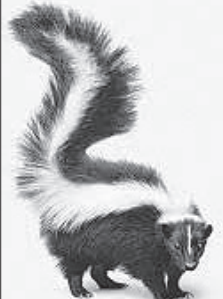

Increase rabid skunk cases reported in Lavaca County
According to Zoonosis control veterinarian, Dr. Amanda Kieffer, there have been three rabid skunk cases reported recently in Lavaca County.
“We’ve seen an increase in skunk rabies in the area that have been spilling over into Lavaca County from Victoria County,” Kieffer said at the Monday, June 26, Commissioners’ Court meeting.
Based on data provided by Kieffer’s office with the Texas Department of Health Services, there have been three reported cases of skunks infected with rabies for the county in 2023 with Victoria County having 10 cases of rabid skunks and one case with a bat carrying the virus.
The DSHS website describes rabies as a virus that affects the central nervous system (CNS) and humans can be infected with the rabies virus.
All mammals, and man, are susceptible to rabies, which in almost every case is fatal.
The disease is transmitted by an infected animal biting or licking and the virus enters the body through a break in the skin, or in rare cases, through mucous membranes such as the eyes, nose or throat.
Affecting the CNS, it may take 10 to over a year to develop, however exposed people can be successfully treated through a series of vaccinations before symptoms develop.
Wildlife is the main source of infection for domestic animals, including pets and the disease can be transmitted to many from an infected wild or domestic animal.
The DSHS list signs of what to watch for in determining an infected animal include:
•Bold “friendly’ or apparently tame wild animals.
• Night animals, like skunks and foxes, that are seen in the daytime.
• Pets that have difficulty walking, eating or drinking.
•Signs of excitement or viciousness in normally quiet animals.
• Animals that tear or scratch an old wound until it bleeds.
•Cattle that “strain” for long periods.
•Bats that are unable to fly
In early stages of the disease, the personality of pets may change such as a normally friendly dog may stay alone while another may begin to seek more attention
Later the symptoms may follow a furious pattern or dumb(paralytic) pattern, or a combination of both.
A veterinarian should be consulted immediately when any of the signs are first noted.
The DSHS list steps for controlling rabies in a community that include:
•Have pets (dogs and cats) over four months of age vaccinated by a veterinarian.
•Register and license all owned dogs and cats.
•Impound all stray dogs and cats.
•Appoint an animal control officer and provide a pound or shelter facilities.
•Euthanize and test all biting dogs and cats, or quarantine them for daily observation by a veterinarian for a period of 10 days.
•Dogs and cats bitten by a known rabid animal should be destroyed immediately. If the owner is unwilling to have it done, the unvaccinated animal should be vaccinated immediately and placed in strict isolation for 90 days. A booster vaccination should be given during the third and eighth week of isolation. If the animal is currently vaccinated, it should be revaccinated immediately and restrained, leashed and confined for 45 days.