

Ecosystem river tour
By Clayton Kelley
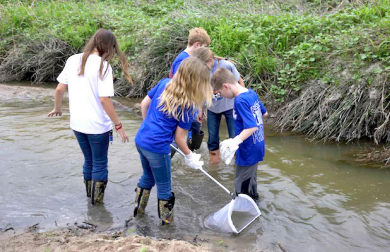
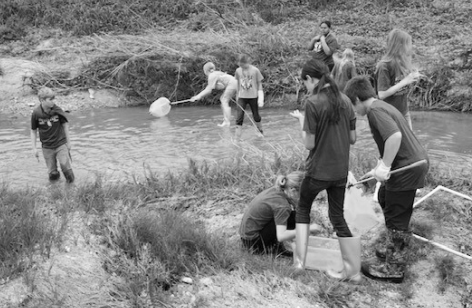
The Hallet Oak Gallery held an ecosystem river tour for students from Sweet Home ISD last Thursday, March 7.
The purpose of this tour was to have students experience the Lavaca River and learn about its ecosystem through art and science.
“The students were very engaged during this program,” Hallet Oak Gallery Executive Director Mieko Mahi said. “Programs like these are incredibly important.”
There were 33 students from Sweet Home Elementary School who attended. The first thing the students did was watch an educational video.
“The film was called ‘The Secret Life of Rivers’ and it’s about the hyporheic zone,” Mahi said. “It was really entertaining and informative and a great beginning for the class.”
The hyporheic zone is the region of sediment and porous space beneath and alongside a stream end, where there is mixing of shallow groundwater and surface water.
Students were then divided into teams and went out to the river to collect samples of organisms like clam shells, benthic macroinvertebrates, and plants.
“Students were given a container to fill with seashells mixed with stuff like a squashed coke can or plastic water bottles or bottlecaps. This was to show kids that there may be some waste in the river that doesn’t need to be there with this environment that they may not be familiar with,” Mahi said. “I then gave them a net with another container, and they were asked to put their invertebrates in. An invertebrate is an animal without a backbone and it’s the size of a freckle. The students had to get in the water and pick up rocks and get the bugs from underneath the rocks.”
Students were then able to come back to the gallery and look at the invertebrates under a microscope.
“It’s really awesome because when you look at it, you’re just looking at a dot moving around,” Mahi said. “But when you look at it under a microscope, you can see the eyes or the hair on their legs. This gave students an opportunity to learn about the ecosystem in the Lavaca River. I had a chart of all these invertebrate, and the kids were able to look at the chart and tell me what (species) they found.”
The invertebrates that the kids found can also identify the health of the river.
“It will tell you whether the river is in poor quality, fair quality, or excellent quality,” Mahi said. “These kids found crayfish. That means this river is in fair quality for that (organism) to survive."
The students also collected plants at the Lavaca River
“The kids downloaded an app on their phone called Seek,” Mahi said. “What’s so special about this app is that it’s designed for children. It’s cool because you can take your phone and point it at something, and it will tell you what you’re looking at. It can tell you where a seashell is from, and it can also identify insects, rocks, and plants. It was a good method to get kids to inquire what kind of plants it was that they found.”
Students also were able to hear a presentation from biologist, Chad Kinsfather, from the Lavaca Navidad River Authority. He is the Director of Environmental Services.
“He monitors the quality of the river here in Hallettsville,” Mahi said. “One of the things he discussed was how to handle a turbidity test. He was telling the kids what it was and how it works and how to use it. A turbidity test shows how clear the water is at Lavaca River. I’ve done this test, and I can tell you that this river is very, very clear. Kinsfather said this river is cleaner than most other rivers (in Texas).”
Mahi received training from the National Oceanic Atmospheric Administration to sponsor this event.
“It was a three-day training event and what was really cool about it was that I was among science teachers and river caretakers,” Mahi said. “What amazed me was that these people came from all over and none of the teachers had the experience that I was given. I’m passionate about it and I’d like schools to take this tour with me and then implement it into their own program to where they can do it on their own.”
Sweet Home Elementary teacher, Desiree Munich, said this program went really well and the students had an excellent time.
“(It was) fantastic,” Munich said. “The kids loved trying to identify and observe what they brought back from the river. The tube activity to check the visibility of the water was a big hit. I think this age and up would find this type of exploration exciting, especially exploring in their local river. The kids said they want to come back with their families. I would recommend this trip for students.”