

Recent quasar discovery changing our understanding of galaxies
‘Black Hole Sun’ burning a quadrillion times brighter that our sun
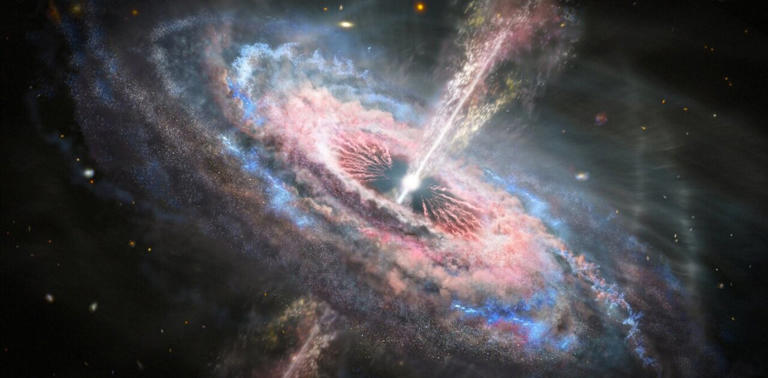
Peering deep into the infancy of the universe, the European Southern Observatory recently confirmed the discovery of the brightest and fastest growing quasar ever spotted in space.
Quasars are luminous objects in the night sky powered by gas falling into a large black hole at the center of a galaxy.
The discovery of this record-breaking object would be fascinating enough by itself, but its discovery raises big questions about galaxy formation in the early universe.
The biggest thing vexing scientists is how this quasar, which existed less than two billion years after the Big Bang, could have grown so large so quickly. It’s enough of a conundrum, scientists say, that it could even lead to a rethink on how galaxies came to be.
Black Hole Sun?
It’s not just a Soundgarden song anymore. Black holes, the densest objects in the universe, are given this name because their gravitational pull is so incredibly strong that not even light can escape their grasp.
How then, can a black hole be the origin of such an intense light source? Well, in some galaxies, where the black hole is sufficiently large, matter is being drawn in at a ferociously high rate.
As it spirals in, violent collisions between gases, dust, and stars result in the emission of huge amounts of light energy. The bigger the black hole, the more violent the collisions and the more light is emitted.
The black hole is growing rapidly by consuming a record-breaking amount of mass, equivalent to one sun each day. This intense accretion of matter releases an amount of radiative energy that's equivalent to a quadrillion (thousand trillion) suns.
So, how did we miss it?
How, exactly, did something that bright in the night sky go undetected for so long, despite decades of astronomical observations?
The sneaky quasar was hiding in plain sight, it turns out.
Despite its astonishing luminosity, J0529-4351 is very distant, meaning that it seamlessly blends in among a sea of dimmer stars that lie much closer to Earth.
In fact, this quasar is so far away that the light it emits takes a whopping 12 billion years to reach us here on Earth.
The age of the universe is around 13.7 billion years. So, this quasar existed just 1.7 billion years after the Big Bang, at the beginning of the universe.
How do we know all that?
The universe's expansion following the Big Bang is what permits us to measure the distance to, and therefore the age of, this quasar.
A long-known simple formula called Hubble's law, states that knowing the velocity that an object is moving away from us allows us to calculate how far away it is.
The collisions that occur as matter spirals into this quasar's black hole raise it to scorching temperatures of 10,000°C. Under these conditions, the atoms in the system emit a characteristic spectrum of light.
These discrete frequencies of light form a sort of barcode that astronomers can use to identify the elemental compositions of objects in the night sky.
As an object that's emitting light moves away from us, the frequency of that observed light undergoes a shift, much like how the sound frequency of an ambulance siren shifts depending on whether it is driving towards or away from you.
This shift seen in astronomical objects is known as redshift. This, along with Hubble's Law, has permitted both the age and the distance (both these properties are linked in cosmology) of J0529-4351 to be confirmed.
So, what’s with the rethink on galaxy formation?
This bright beacon from the early universe has raised an important question that is baffling astronomers: how could this black hole, in such a relatively short period of time, grow so fast into such a massive object? Under well accepted models of the early universe, it should have taken longer for it to grow to this size.
What's more, by tuning the artificial intelligence (AI) models used to scan telescope data for these unusual objects, more could still be found in the coming years. If they resemble J0529-4351, physicists would need to seriously rethink their models of the early universe and galaxy formation.
The fastest-growing black hole ever observed will be the perfect target for a system called Gravity+, an upcoming upgrade to an instrument on the Very Large Telescope called an interferometer. This interferometer is an ingenious way of combining data from the four separate telescopes that actually make up the VLT.
Gravity+ is designed to accurately measure the rotational speed and mass of black holes directly, especially those that lie far away from the Earth.
Furthermore, the European Southern Observatory's Extremely Large Telescope, a 39-meter diameter reflecting telescope, is currently under construction in the Chilean Atacama Desert.
This is designed for detecting the optical and near-infrared wavelengths characteristic of distant quasars and will make identifying and characterizing such elusive objects even more likely in the future.