

Iwo Jima: A battle key to Pacific front victory of WW II
Eighty years ago as World War II raged on in the Pacific Theater, there was a small island, known as Iwo Jima, located approximately 750 miles from the mainland of Japan.
According to History.com and Military.com, the island had developed mainly from a volcano and was covered with sand and lava ash, and had many caves located on it.
It appeared useless, but it also had three airstrips and was occupied by the Imperial Japanese Army.
Because the island lay directly under the flight path of the B-29 bombers as they flew from Guam, Saipan or the Mariana Islands on their way to bomb Japan, it was determined to be a very strategic area for the U.S. to control.
Admiral Chester A. Nimitz played a big role in devising a plan for gaining control of the island.
On February 19, 1945, the battle of Iwo Jima began and turned out to be a key battle in bringing an end to the war with Japan.
The battle lasted over a fiveweek span and was considered one the bloodiest in Marine Corps history.
On that day in February, the Marines conducted an amphibious landing on the island.
However, because the island’s beaches was made up of steep dunes composed of soft gray volcanic ash, it made footing unsteady and the vehicles having a difficult time traveling on it.
In addition, the Marines were met with many other unexpected challenges.
Besides the treacherous footing, the invading Marines had thought the pre-attack bombing by U.S. Naval ships had been successful, but the gallant heroes taking on that island were surprised by the Japanese, who laid in wait.
In those first days of fighting, the Americans, although outnumbering the Japanese, the artillery positions of the enemy in the mountains would open fire and stalled the Marines advancement.
In addition, as the Marines moved forward in advancement of the island, the Japanese would lie in hiding in the caves and attack the Marines after they passed by their location.
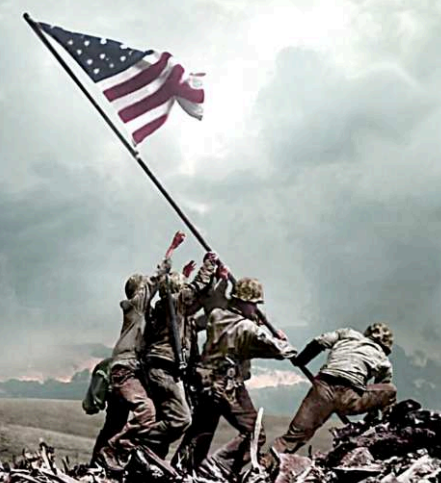
After just four days of fighting on Feb. 23, 1945, the Marines captured Mount Suribachi and this is when the famous raising of the American flag took place.
The iconic photo was taken by Associated Press photographer Joe Rosenthal, who won a Pulitzer Prize for the photo.
In recounting his taking of the famous photo, Rosenthal said he had just come to the top of Mount Suribachi, the highest point on the island, when a group of American Marines after heavy fighting, raised a flag of the United States.
The flag, however, was too small, so it was decided to replace it with a larger one, so it could be seen from much longer distances to boost the morale of the Marines and demoralize the enemies.
The battle of Iwo Jima continued until March 25, when the Japanese mounted a final banzai (suicide) attack.
During the attack, the Marines sustained a number of casualties, but ultimately won the battle the next day and Iwo Jima was now controlled by American forces.
Although the major fighting ended, during the next few weeks the Marines plodded through the island’s jungle, seeking to capture or kill any Japanese holdouts, who continued to fight and refused to surrender.
The Marine Corps victory at Iwo Jima was considered a turning point in World War II.
After capturing Iwo Jima, the island served as a crucial air base for American fighter planes.
It gave the Allies a base to launch air raids against Japan and also providing a staging area for bombing runs and an emergency landing point for the U.S. Army Air Corps.
In all, the battle took 36 days with more than 26,000 American casualties and nearly 6,900 Marines and Navy Corpsman dying.
An estimated 20,000 Japanese soldiers lost their lives during the fighting.
Today, there are two Iwo Jima statues erected in the United States.
One is located outside of Arlington National Cemetery in Arlington Ridge Park in Virginia, just across the Potomac River from Washington D.C.
The second is located at the Marine Military Academy (MMA) campus in Harlingen, Texas.
The statue is a powerful tribute to heroic actions of six Marines, who raised the flag and to all the Marines who gave their lives in the bloody battle.
The original flag raised on Mount Suribachi can be found at the National Museum of the Marine Corps in Quantico, Virginia.
In 2006, actor/director Clint Eastwood made two movies that depicts the events of the Battle of Iwo Jima. The two movies were Flags of Our Fathers and Letters from Iwo Jima.