

Preserving History: Shiner Palace Saloon and Ehlers Cigar Factory earn Historical Markers

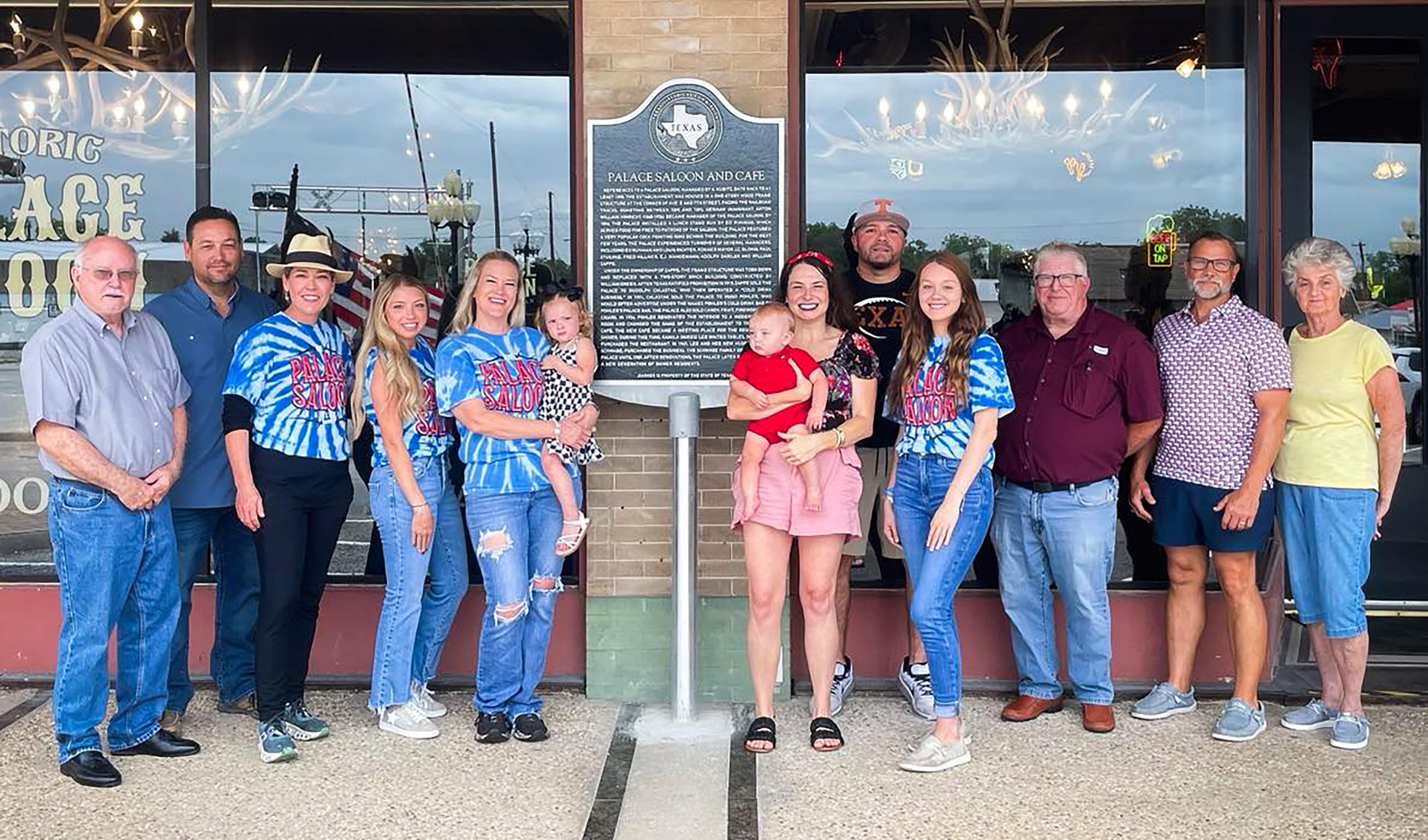
The Texas Historical Commission (THC) has recognized the Palace Saloon and Café and the Ehlers Cigar Factory as a significant part of Texas history by awarding them an official Texas Historical Marker.
The Dickson-Allen Foundation gave the THC grant money to pay for the markers. The Palace Saloon Marker cost $2,300 and the Cigar Factory marker cost $1,200.
“Both of those businesses met the criteria for the markers,” Lavaca County Historical Commission Chairman Doug Kubicek said. “One of the guidelines for getting a marker includes having the places being over 50 years old. The marker for the Cigar Factory was placed with the building because it was moved from another location in Shiner to where it is today.”
Kubicek said this was part of a larger effort to recognize local history. “This recognition impacts the local community,” Kubicek said.
“We are in the middle of tourist season. We get people who love to tour Lavaca County, and these markers are great for that. Both of these sites are unique and special to the community. Everyone in the community can identify with these sites.”
History of Palace Saloon
The Shiner Palace Saloon has long been a part of Shiner’s rich cultural fabric. Historical records trace its roots back to at least 1890, when A. Kubitz managed the original Palace Saloon—a modest one-story wood-frame structure located at the corner of Avenue E and 7th Street, facing the railroad tracks.
“The bar is one of the original bars in Shiner,” Kubicek said. “The town of Shiner changed dramatically after 1887. Originally the town of Shiner was outside of the area. When the train came in through Shiner, the people decided that near the railroad track was where commerce was going to be.
So they picked up the town and moved it and started the town of Shiner. The Palace Saloon contributed to that. All the buildings faced the train track.”
In its early years, the saloon attracted attention not only for its libations but also for its colorful additions: by 1894, a lunch stand operated by Ed Ruhman served free food to patrons, and a popular cockfighting ring drew crowds behind the building.
“The idea of fighting roosters is horrible, but people acknowledge what life was back then and that’s what they did for entertainment,” Kubicek said.
Over time, the Palace saw a steady turnover of managers, including notable local figures such as former Mayor J.C. Blohm and several businessmen—among them Paul Stuerke, Fred Hillmer, E.J. Wagenmann, Adolph Darilek, and William Zappe.
Under Zappe’s ownership, the original structure was replaced with a more substantial two-story brick building, constructed by William Green. Prohibition in 1919 marked a turning point: Zappe sold the business, and by 1921 it had changed hands again, landing with Hugo Pohler. Pohler rebranded the establishment as Pohler’s Cold Drink Bar and later, in 1934, renovated the interior to create the Palace Café—a modern dining spot that became a popular community gathering place.
During this time, Kamila (Mikes) Lee worked at the café as a waitress. She eventually purchased the restaurant in 1942 and, after marrying Hugo Schwabe in 1947, the couple continued to operate the business. The Schwabe family ran the Palace until 1989, helping to solidify its role as a cornerstone of local life.
Following renovations, the Palace reopened and continues to welcome a new generation of Shiner residents, preserving a legacy more than a century in the making.
History of Ehlers Cigar Factory
The Cigar Factory was recognized after the great-great granddaughter of founder Louis Ehlers, Alex Thompson, became interested in getting the historical marker for the factory.
“She was working on at the time her master’s degree in public history at Texas State University,” Kubicek said. “Her professor encouraged her to go on in getting the historical marker.”
The Cigar Factory is a business that helped put the community on the map in the late 19th and early 20th centuries. Founded by German immigrant Louis Ehlers, the factory was established in 1894 in a small structure located on Avenue H, just in front of the Ehlers family home.
Ehlers had arrived in the United States in 1870 and eventually settled in what would become Shiner. After marrying Alwine Wied in 1893, he quickly became a prominent figure in the town’s economic development.
The Ehlers Cigar Factory was among Shiner’s first major business. Employing five skilled union workers—each paid one cent per cigar—the factory produced hand-rolled cigars that were packed in wooden boxes and shipped across Texas.
“Ehlers had to employee union labor,” Kubicek said. “He found out that you can grow tobacco, but it isn’t really made for growing in South Texas. There’s too much humidity. Louis started making cigars and he realized it wasn’t selling, so he started buying bulk tobacco from places like Cuba and Mexico. He would have it shipped in with big bundles and then began rolling his own cigars.”
This was the second Cigar Factory owned by Ehlers. Ehlers’ cigars gained popularity far beyond Shiner, with loyal customers in cities such as Pecos and Wichita Falls.
Profits from the venture were funneled back into the local economy, reflecting Ehlers’ commitment to the growth of his adopted hometown. The factory operated until 1945, and while the original building was eventually relocated, its legacy remains a vital part of Shiner’s story.
The unveiling of the markers occurred on July 5. Members of the Historical Commission were in attendance at both of the unveilings.
The Boothe family was there for the Palace Saloon. Thompson, great-great granddaughter of Ehlers, was unable to attend the unveiling of the Cigar Factory due to the flooding in the state.