

Garrisons and Gunfire: The Violent Reconstruction Days of South-Central Texas
By Murray Montgomery
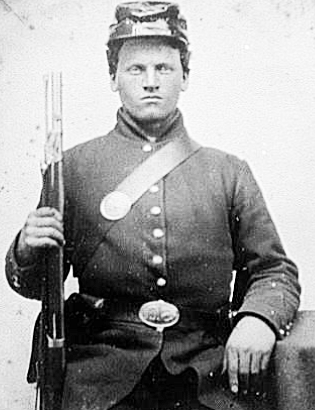
After the Civil War ended, folks in Texas and throughout the South underwent a phase in time known as "Reconstruction."
During this period, the states that had previously been part of the Confederacy were now subject to military rule as well as occupation by Union troops. Citizens of Gonzales, and other surrounding towns had to deal with the problem of enemy soldiers, in their hated blue uniforms, walking the streets - some who may have felt that the local folks were inferior to them.
A story in the March 26, 1931, issue of The Gonzales Inquirer prompted me to do some research on an incident involving U.S. Army soldiers that occurred in Gonzales in 1868. The article was about a former resident of Gonzales who had donated a rare photograph to the University of Texas Library. The paper described the picture as, "...depicting a scene of an early tragedy." This tragic event was said to have happened in Gonzales during the reconstruction days.
This incident turned out to be the killing of a local man by Union soldiers. After the Inquirer article was published, a citizen of Gonzales, Mr. F.F. Wood, came forward and said he definitely remembered the occurrence. Wood said it happened at the old Keyser House in Gonzales. The Keyser was a hotel located in the downtown area. Wood stated that the victim was a physician from Belmont by the name of Cunningham.
Wood said that Dr. Cunningham was, "called out" by the soldiers and when he appeared at the top of the stairs, they grabbed and pulled him feet first down the steps, and then shot him on the sidewalk. Wood said Cunningham had done something to offend the soldiers.
Another article about the killing of Dr. Cunningham appeared in the Inquirer on April 2, 1931. One local lady, Mrs. W.J. Bright, told the paper that she recalled the event quite clearly. She was 15 years old at the time. Bright stated, "So many shots were fired, that everyone in the house thought a battle was on in the business section." She said that she later learned that the soldiers shot into every business in town to intimidate the storeowners and keep them inside while they killed Cunningham.
According to Mrs. Bright, the soldiers ordered Cunningham to kneel on the sidewalk and pray for his life. She said he was kneeling in prayer when he was shot to death.
Evidently the soldiers were running roughshod over the local folks. The problem was bad enough that the mayor complained to military authorities in February of 1868, accusing the men of threatening local citizens. Several months after Dr. Cunningham’s death, two soldiers were accused of murder. They were tried by a military court and found not guilty.
My research found that Union occupation forces in Texas arrived starting in June 1865. These troops were deployed inland from coastal landing points (e.g., Indianola/Green Lake) to places like San Antonio, Victoria, and smaller towns to restore order.
Gonzales was explicitly noted as a "hot spot" by Federal officers. The 32nd Indiana Infantry helped garrison the town, strengthening the post amid tensions with locals. As previously noted, violence and resistance occurred between soldiers and civilians there. The 32nd (a veteran unit of German immigrants) was part of the broader Fourth Corps movements through the area in 1865 before mustering out in Texas by late 1865.
According to the Texas State Historical Association, Shiner and Hallettsville were likely covered by the same or closely related garrisons, as occupation forces operated across nearby counties in the south-central Texas interior. Lavaca County had a Confederate-leaning history, so small detachments would have been logical extensions of the Gonzales post.
The reconstruction nightmare for Texas officially ended on March 30, 1870, when President Ulysses S. Grant signed the act readmitting Texas to the Union.