

Bishop: Catholics can eat meat on St. Patrick’s Day

Catholics within the Victoria Diocese can grab for their traditional corned beef and cabbage, Irish stew or corned beef and hash dinners guilt free this year for St. Patrick’s Day.
Despite St. Patrick’s Day falling on Friday this year—which typically requires all practicing Catholics ages 14 and older to abstain from eating meat (that would be beef, pork or chicken; seafood is OK) during the Lenten season (the 40 days prior to Easter each year, marking Jesus’ rising from the tomb to defeat death, one of his final earthly miracles recorded in the New Testament so that his disciples might truly know he was the son of God—Victoria Diocese Bishop Brendon Cahill issued word last Friday, along with several other Texas bishops, that Catholics could dispense with the meat abstinence obligations, just this once, in honor of St. Patrick’s Day, typically a day of revelry especially among Irish Catholics.
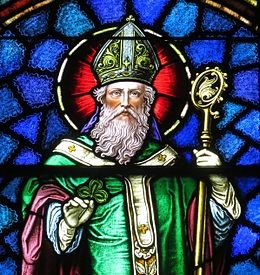
St. Patrick, you see, is revered in Ireland and in many other Catholic parts of the world, primarily for his work in converting the Irish, a mostly pagan people originally, to the Catholic faith around the 5th Century A.D. (although many modern historians now believe his was not the only nor the first influence in their conversion; in fact, recent studies of early Latin texts suggest entire schools of priests, friars and clerics had been hard at work on conversions in Ireland as early as the 2nd Century A.D., at least 200 years before St. Patrick’s lifetime).
Solely responsible or otherwise, St. Patrick came to earn the reverence he later received.
Born in the Roman-held territories (in what scholars believe was likely the modern-day England or someplace nearby), the future patron saint of Ireland first came to know of the Irish when he was kidnapped by them as a boy and held captive for six long years as their slave, forced to tend their livestock.
He escaped his bondage when he was about 20, returning to his family at first, but later turning to the church. It seems his time in captivity led him to a more spiritual calling.
As a young cleric, he returned to Ireland, where he did much in the way of Christian conversions there. He even rose in rank within the priesthood to become a bishop before he died, some even say first abbot of Glastonbury Abbey.
Little record exists of what he actually did during those years, exactly. But the legends exist in multitude. One of the most famous of those involves St. Patrick driving all the snakes from Ireland, a large island country that’s notably absent of serpents to this day still.
St. Patrick has been called the Apostle of Ireland, and he is esteemed by many on the same level as Jesus’ original 12 disciples. Interestingly, however, the good St. Patrick was never officially canonized by the church. Canonization was a practice adopted several centuries after most people simply accepted him as such, so his title stuck.
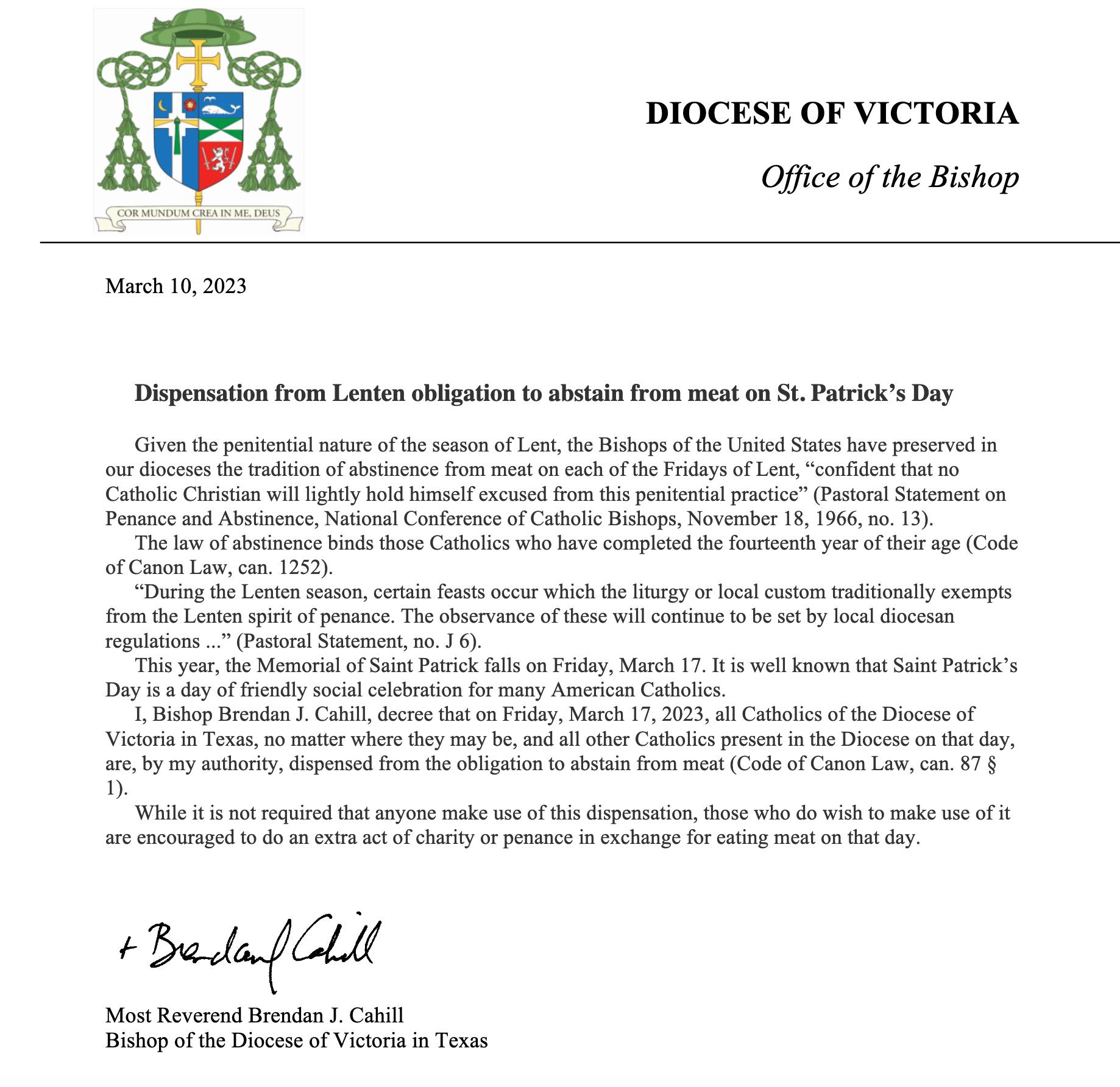
“During the Lenten season, certain feasts occur which the liturgy or local custom traditionally exempts from the Lenten spirit of penance. The observance of these will continue to be set by local diocesan regulations,” Bishop Cahill wrote in last week’s dispensation order, quoting from long held traditions in the Catholic Church.
“This year, the Memorial of St. Patrick falls on Friday, March 17 (which is widely believed to be the day St. Patrick died, which is why that date was picked for his feast day). It is well known that Saint Patrick’s Day is a day of friendly social celebration for many American Catholics. I, Bishop Brendan J. Cahill, decree that on Friday, March 17, 2003, all Catholics of the Diocese of Victoria in Texas, no matter where they may be, and all other Catholics present in the Diocese on that day, are, by my authority, dispensed from the obligation to abstain from meat (Code of Canon Law, can. 87 §1).
“While it is not required that anyone make use of this dispensation, those who do wish to make use of it are encouraged to do an extra act of charity or penance in exchange for eating meat on that day,” the bishop added, signing it as the “Most Reverend Brendan J. Cahill, Bishop of the Diocese of Victoria in Texas.”