

Celebrating Hispanic Heritage Month, Texas Missions should also be included
By Murray Montgomery
Staff Writer
In the beginning, the honoring of Hispanic heritage was limited to one week. The observation was started in 1968 when President Lyndon Johnson proclaimed it to be “Hispanic Heritage Week.” President Ronald Reagan expanded the event to 30 days in 1988 - thus it became known as “Hispanic Heritage Month.” It was set to run from Sept. 15 through Oct. 15 - these dates were enacted into law on August 17, 1988.
The United States Census Bureau provides more information about the observation of National Hispanic Heritage Month and the reason for it being established, “The day of September 15 is significant because it is the anniversary of independence for Latin American countries Costa Rica, El Salvador, Guatemala, Honduras, and Nicaragua. In addition, Mexico and Chile celebrate their independence days on September 16 and September 18, respectively. Also, Columbus Day, which is October 12, falls within this 30-day period.
“Our culture has been enriched by the rhythms, art, literature, and creativity of Hispanic peoples. Our deepest values have been informed by the love of family and faith that is at the core of so many Hispanic communities. All of these contributions help us realize the promise of America for all Americans.”
Honoring the contributions to our culture by Hispanic people is acknowledged all across America, as well it should be, but it is something that folks living in the southwest are exposed to every day. The art, food, and music are a part of their lives 24/7 - it is a reminder of how the Spanish, Mexican, Indian, and Anglo culture is intertwined into a beautiful fabric of love and respect for those who are proud to be Americans.
The border states are surrounded by architecture that originated in Spain and found its way here many years ago by explorers searching for a new world.
They hoped this new world would be full of gold and other riches but instead, they found poor Native Americans who weren’t that fond of the European invaders. As was the way back then, the Spanish sought to conquer the country and expand their hold on the new land.
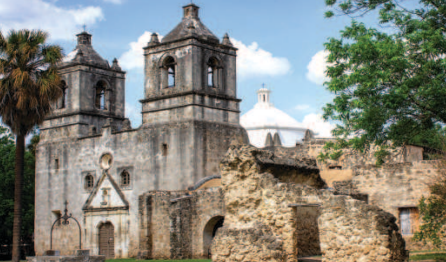
Texans can step back in time by visiting cities like El Paso, San Antonio, and many others around the state. My favorite, San Antonio, is a chronicle of Hispanic history. A trip to that city will surround the visitors with beautiful missions, a scenic river walk, and some of the best Mexican food to be found anywhere.
There are five Spanish missions located along the San Antonio River - the most famous being San Antonio de Valero (Alamo). I have been to all of these missions, several times - you can’t take it all in with only one visit. The Spanish Governor’s Palace is another “must-see” if you visit the Alamo City. I’ve been there as well, and it’s beautiful.
The National Park Service includes the following information, “The Spanish Governor’s Palace, a National Historic Landmark, is the last visible trace of the Presidio San Antonio de Bexar and the only remaining example in Texas of an aristocratic 18th-century Spanish Colonial townhouse. Plans for the building originated as early as 1722. Upon its completion in 1749, the house served as the Commandancia, or residence and working office of the Captain of the Presidio.”
In my opinion, honoring Hispanic Heritage Month wouldn’t be complete without including the many Spanish missions located in the southwest area of the United States. These structures are a living example of the architectural contributions made to this country by the Hispanic people.