

OLD SHINER GYM—Part II: Shiner tries again for its gymnasium as depths of Great Depression begin to clear
Editor’s Note: Today we bring you Part II in our historical series on the Old Shiner Gym, scheduled to wrap up next week, ahead of the Shiner Academic & Athletic Foundation’s planned casino night fundraiser at the Shiner KC Hall on Saturday, Oct. 15, where they hope to raise some of the roughly $250,000 needed to make some needed building repairs and install climate controls on the 83-year-old gymnasium and auditorium building.
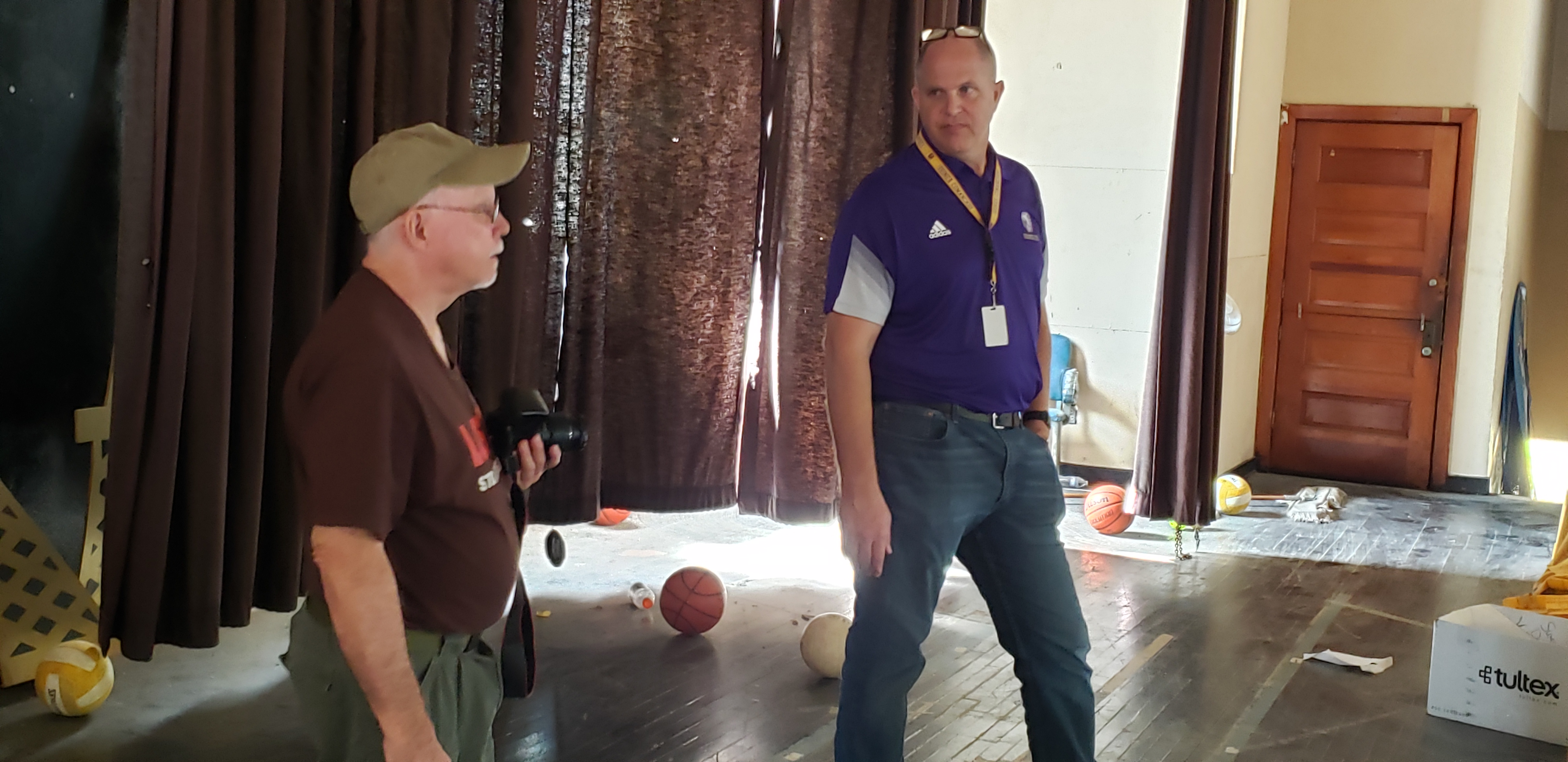
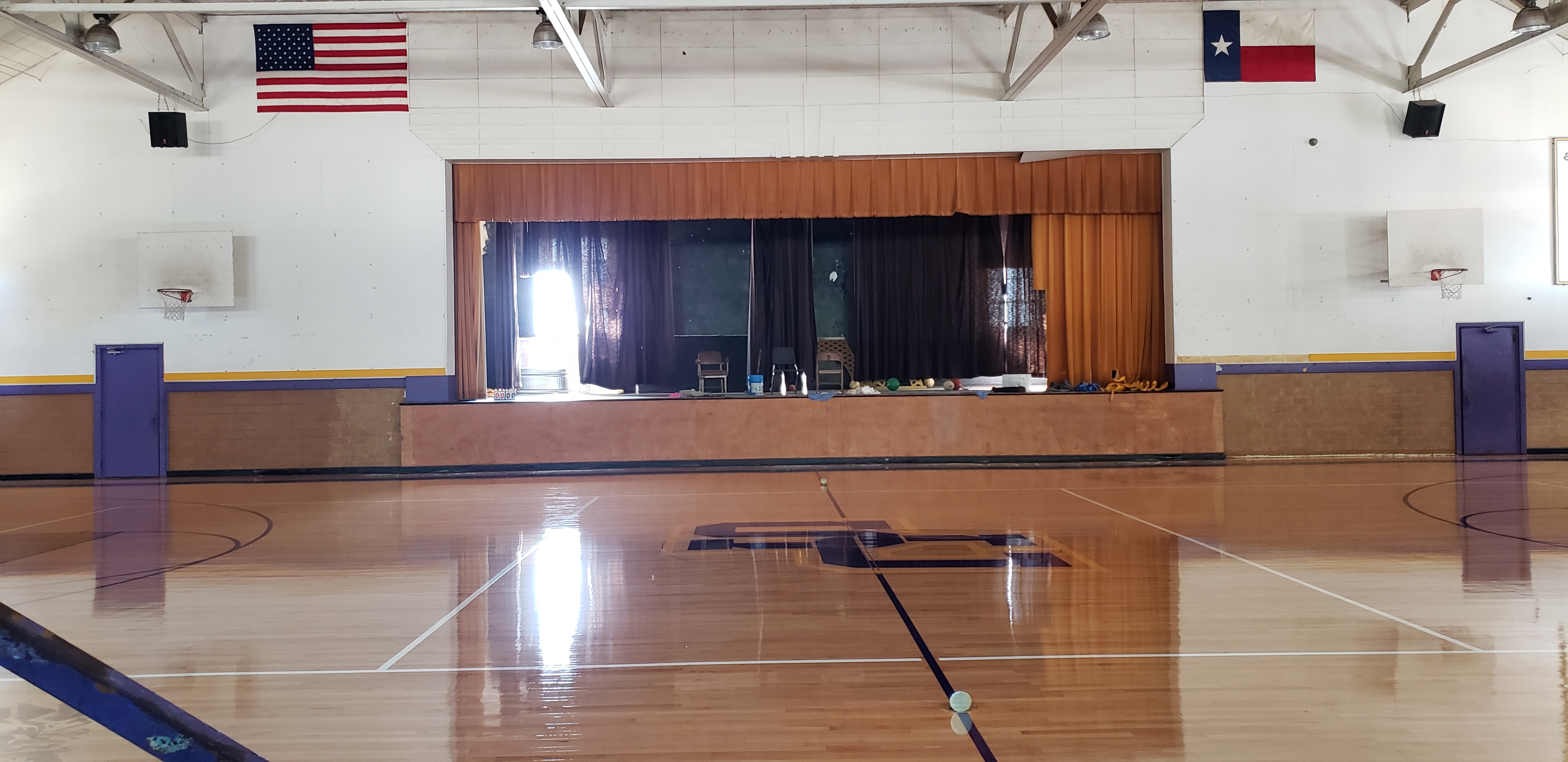
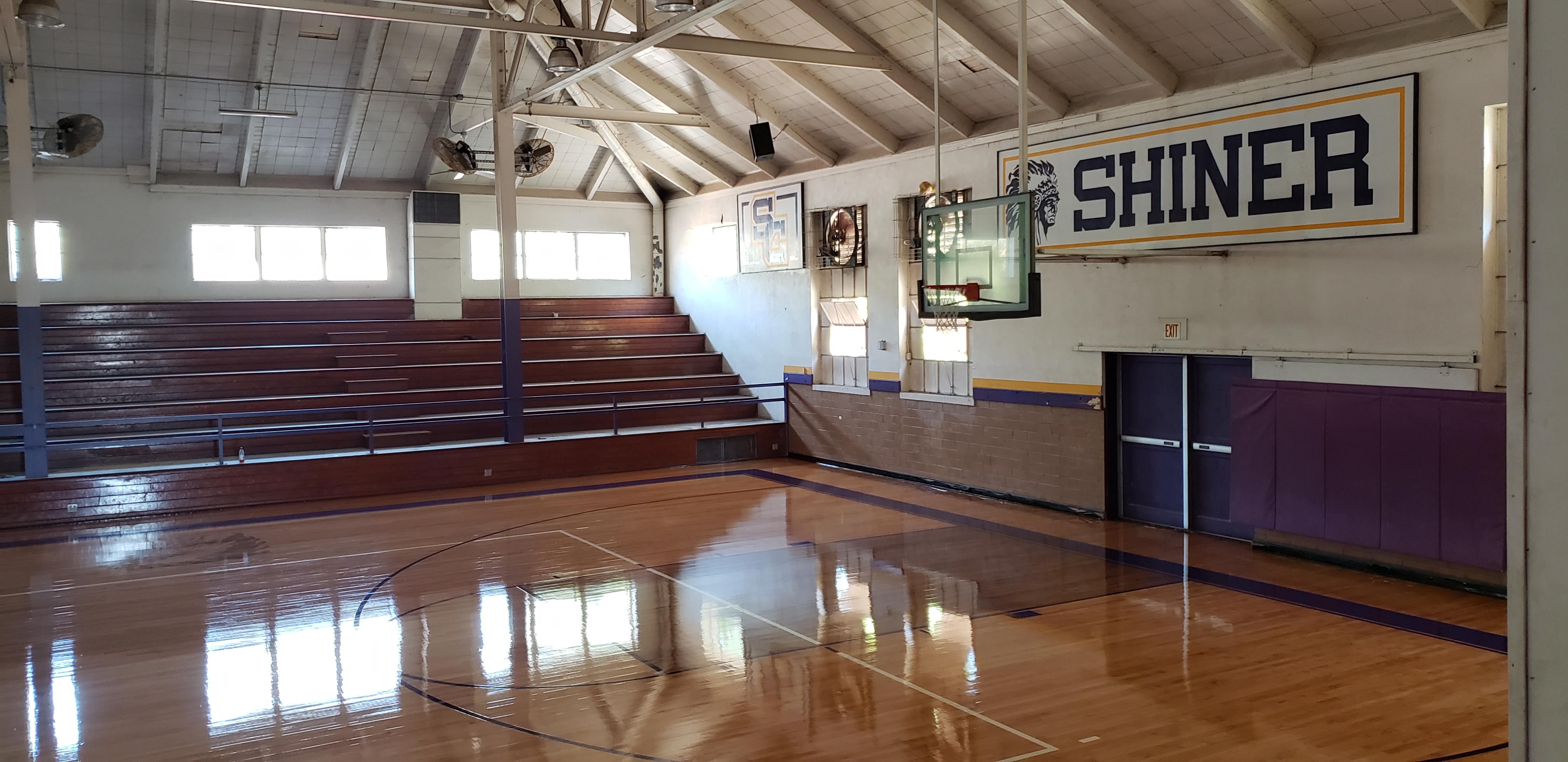


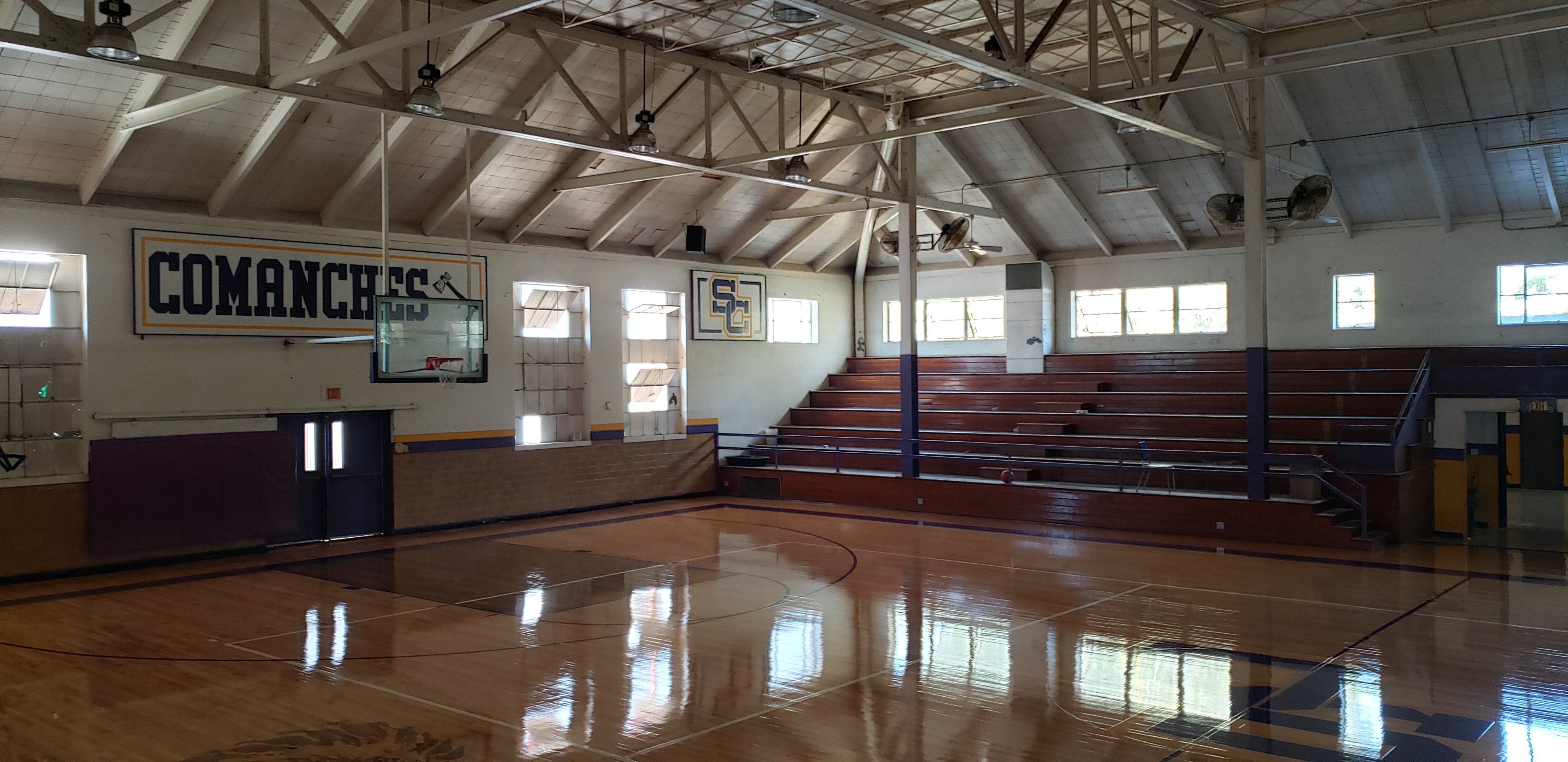
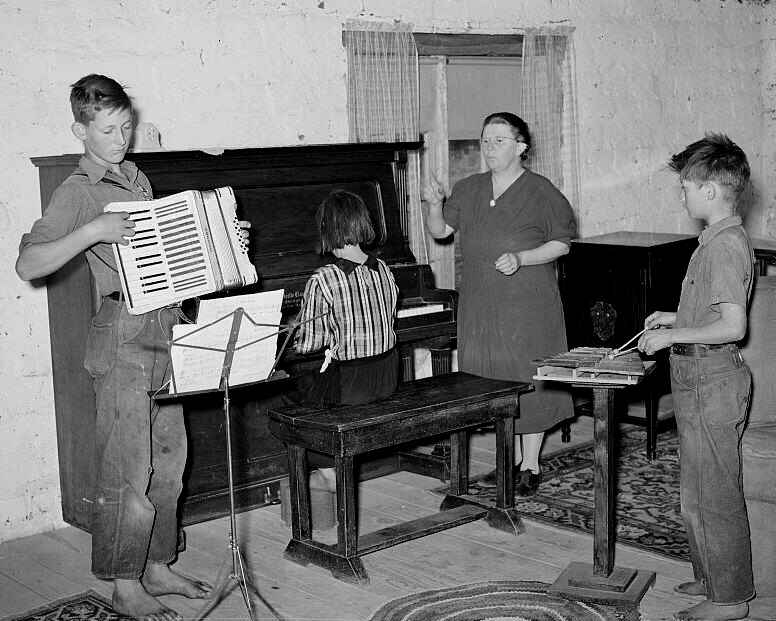
When we left off in last week’s Gazette, we shared a couple stories filed Jan. 22, 1931, which to borrow a phrase that shows up in our pages then, about “a fellow who signs his name” Mr. J.L. Martin and his generous $25,000 donation (worth about $450,000 in today’s dollars) toward the building a school gymnasium/auditorium.
Although it’s a first mention of the story in The Gazette, it was further noted, it also seems to be its last as well. It appears Mr. Martin and his money disappear from our pages, in fact. Albeit 7½ years go by before the gym is mentioned again, during one of the absolute worst economic periods in our nation’s history, better known as the Dust Bowl years of the Great Depression.
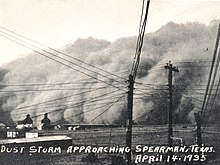
So, how bad was it?
Absolutely horrifying, to read the news accounts. One such story, published out of Kansas in 1933, detailed how one family all but willed a crop out of the parched earth and how, after all that work, a cloud of locusts arrived just days from harvest and gnawed it to the ground. Frustrated, the family patriarch tears off into the fields, “yelling and carrying on as if to scare them away.” Instead, the insects swarm him, “eating the very shirt from his back,” it read.
News stories detail blood-red and coal-black snows falling over various parts of New England and Canada during the mid-1930s, each tinted by whatever color the dirt was from wherever their winds blew in strongest. Chicago newspapers gave an account of city leaders vexed by what to do with the nearly 12 million TONS of dirt that blew in, now clogging their streets.
It led to the largest mass migrations in our nation ever, as chronicled by Nobel Prize winning author John Steinbeck in his Pulitzer-winning The Grapes of Wrath (1939), about how thousands just left, searching for anyplace better than the one at their backs.
A modern American audience can’t fully grasp such times, said Doug Kubicek, president of the Lavaca County Historical Commission.
“We really have no point of reference for anything that bad,” he said. “It was felt everywhere, including here in Lavaca County, which didn’t have it as bad as many did then. At least here, there was always food to eat. Still, people reverted to the barter system, where you’d trade, say, five chickens for some potatoes or milk. Because nobody had any money--none at all—there were entire families who didn’t have two dimes to rub together between them.”
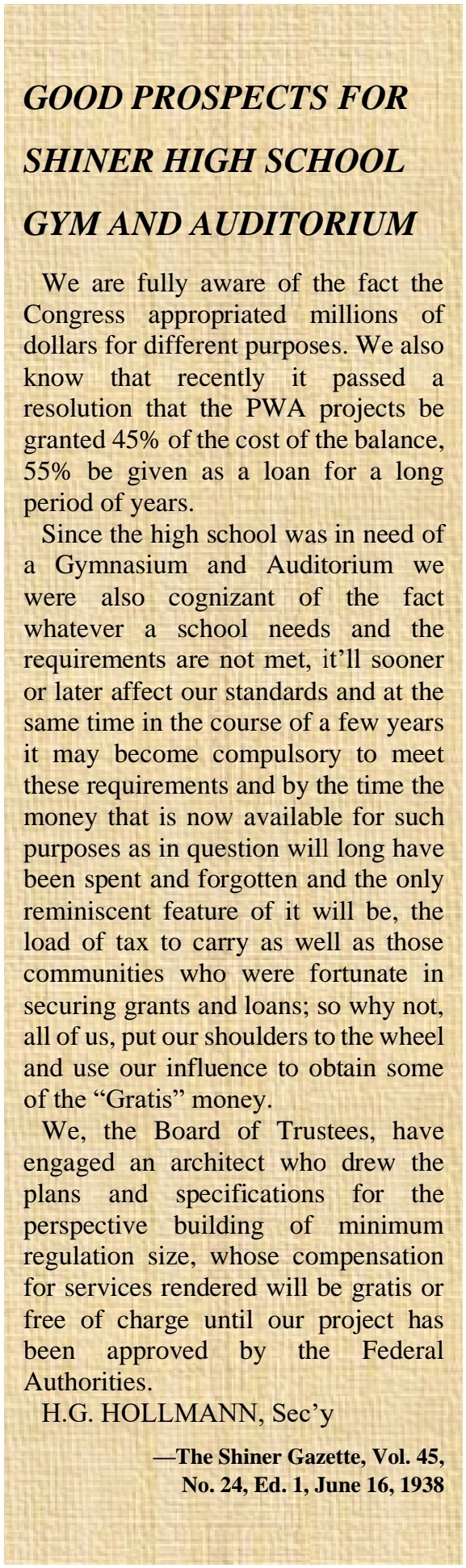
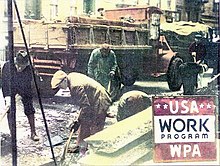
During just such times, talks of a school gymnasium returned to our pages, bolstered largely by a government program begun by President Franklin Roosevelt’s Works Progress Administration, one many New Deal programs aimed at injecting money and jobs back into local economies. Most people knew it only as “the WPA.”
Like most free-spending government programs, the WPA attracted its naysayers. It stood for “We Piddle About,” some circles said, according to encyclopedic articles on the era. Yet it was just such a program that the Shiner school board, heralded by Secretary Herman George Hollmann, relied upon to turn those plans they got back in 1931 into a place the entire community would one day use.
The article to the right there is the first to appear on the gym in 7 1/2 years, but minces no words gets straightaway to the point on what it intends to do. Things will literally fly by over the next few months.
______________________________________________________________________________________________
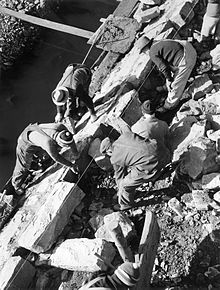

Other items in the news at that same time:
LOCAL POST OFFICE PERSONNEL APPROVED
Word was received at the post office department has approved Mrs. Erna Longoria and Miss Marie Lahodny as regular clerks when the local office passes into the second class on July 1.
Edwin Pohler has recently been appointed sub-clerk. By the office entering into the second class, the public will have an advantage in window service. This will be open all day and not closed for distribution of mail.
On Sundays and holidays all the work is done by the substitute clerk, who is assigned for distribution of incoming and outgoing mail, with instructions from the Post Office Dept. that no mail be delivered to non-box holders on Sunday. On holidays the window will be open at a certain hour which will be announced.
DEDICATION AT DILWORTH
The new Catholic Church at Dilworth will be dedicated Sunday morning, June 19th Sunday with Mons. L.P. Netardus officiating.
A barbecue dinner will be served. Adults 30c, Children 15c. Refreshments, entertainment, music and speaking during the day.
NOTICE
The farmers league will hold a special meeting at Sulphur Park, June 16, at 8 p.m. Several speakers will be there. These special meetings will be a membership drive rally floor Shiner local farmers league. There will be a special meeting at Vlasteuec Hall in the near future. The regular monthly meeting will be at the City Auditorium
AT REST
Hallettsville paid a beautiful tribute to Leo Strauss Wednesday morning, when every business house in the city closed for the funeral hour. This was one of the largest funerals healthier in a long time, where heavy hearts and tears mingled in mutual sympathy. . .
—The Shiner Gazette, Vol. 45, No. 24, Ed. 1, June 16, 1938
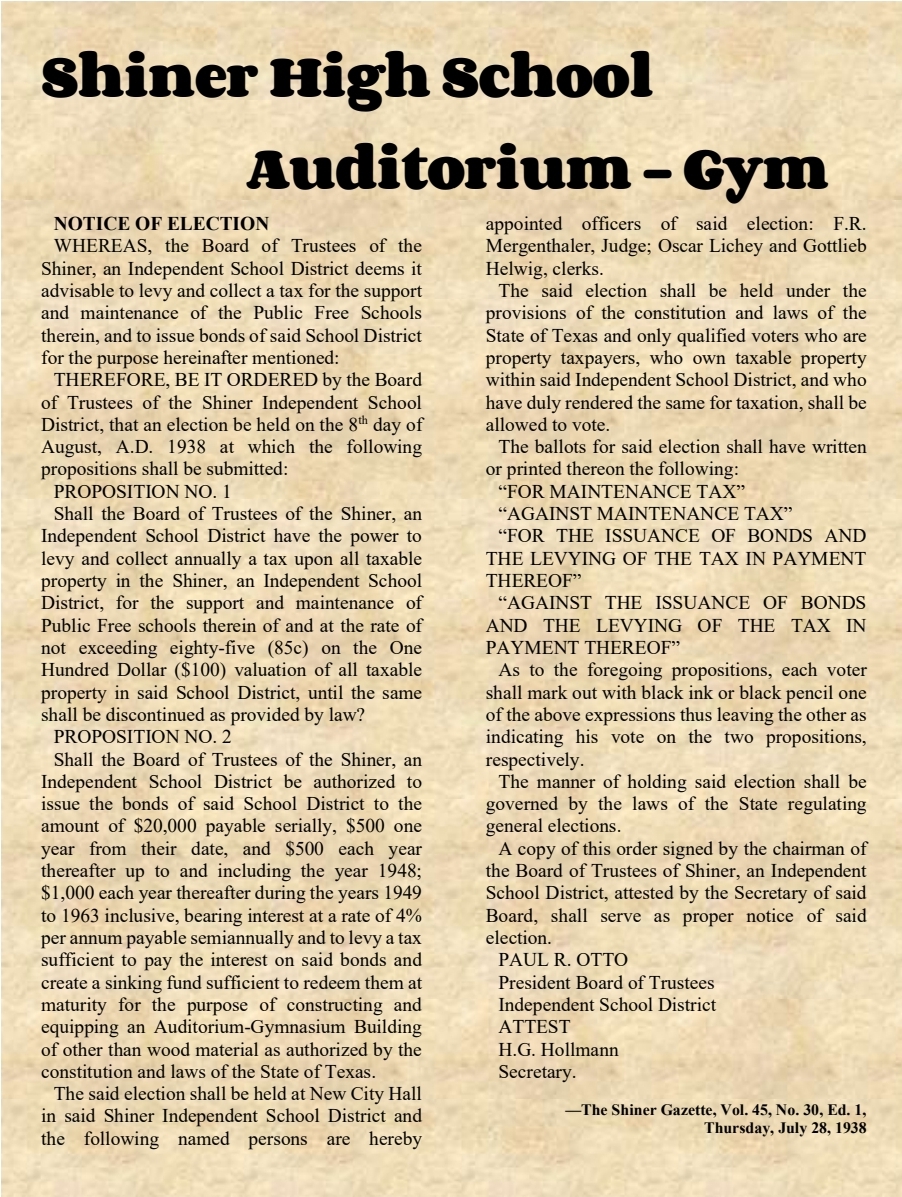
Both of these items, the legal notice above and editorial below, appeared on Page 1 of The Shiner Gazette on July 28, 1938, under the same headline with more than a couple dashes — — separating the two.
I will refer to this particular set of articles once in our third installment next week, but please note the following two items in the above legal notice calling for the election:
1.) In the second column of print, or leg, the first full paragraph, where they say who may vote. Only those who reside within the district, who own taxable property in the district, "who have duly rendered the same for taxation." That sure sounds to me like you need to be paid in full on your tax bill. How do you suppose they might've done that, sans the dimes that Mr. Kubicek spoke of in introductory words about the Depression?
2.) In the same leg of copy, still above, just below the contents of the ballots, listed in all caps, note HOW you had to vote. Using black or pencil only, mark the one you DON'T want, it says. The one you want should be mark free. Based on stories my grandfather told me, such practices were quite common in Lavaca County electioneering, and those running elections like these just loved to switch them up on regular basis, so while here you're supposed to mark out the one you don't want, the next you'd be told to mark only the one you do want, only using blue, perhaps. Especially for many foreigners who barely spoke any English at all, much less could read it, such rulemaking was anything but friendly to them—the first-generation Czechs and Germans from the old country—who still likely held title to much of the farm country surrounding Shiner still, and by virtue of the first item there, the only one from that family entitled to vote.
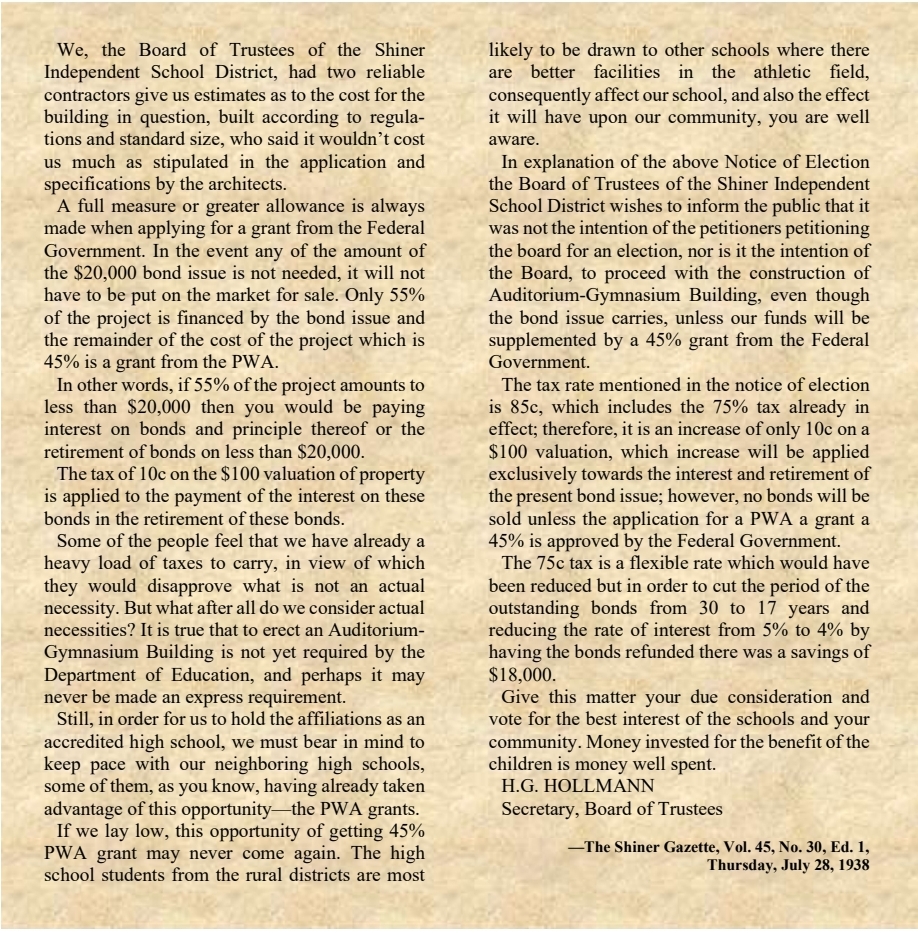
Other items from the news that week included:
ANNIVERSARY BARBECUE TONIGHT
The Business Men’s Club will hold their seventh anniversary barbecue tonight at the Game and Fish Reserve grounds. The members will be accompanied by their ladies.
The committee in charge of arrangements, Messrs Benno Holchak, B.J. Novak and E.L. Balusek announce that the barbeque will be served promptly at 7 o’clock and they urgently request everyone to be on time.
BURGLARIES REPORTED
A number of burglaries have been reported over the weekend. Someone entered Hajek Brothers Meat Market and relieved the cash register of some money. South End Service Station was entered and a few packages of cigarettes taken. The Fruit Stand also reports the loss of some fruit.
So far no clues.
JAMES B. DONNELLY PASSES
James B. Donnelly, a prominent resident of Sweet Home, passed away suddenly Monday at 7 p.m.
Funeral services were held Wednesday morning at the Sweet Home Catholic Church. Interment at the Koerth Catholic Cemetery.
Survivors or two sisters, Miss Nettie Donnelly of Hallettsville and Mrs. J.S. Brewer of Yoakum; three brothers, J.W. and C.E. Donnelly of Sweet Home and J.H. Donnelley of Yoakum.
The Gazette extends sincere sympathy.
—The Shiner Gazette, Vol. 45, No. 30, Ed. 1, Thursday, July 28, 1938
Check us out next week as we conclude our look back at this historic landmark, the Old Shiner Gym, as we examine the vote that made it so, and learn more about its building.
Previous parts to this series already published include The Overview and Part I.
A few more scenes from the times back then:
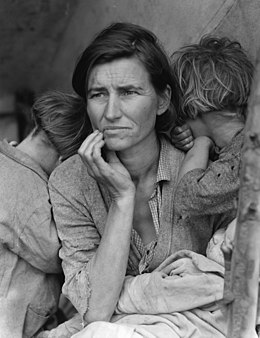
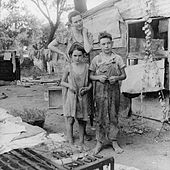
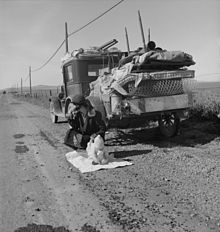
All three of these photos are the same person, Dorothea Lange, and American photojournalist born in 1895 in Hoboken, New Jersey.
One of Lange's most recognized works is Migrant Mother (shown at top above) published in 1936. The woman in the photograph is Florence Owens Thompson. In 1960, Lange spoke about her experience taking the photograph:
"I saw and approached the hungry and desperate mother, as if drawn by a magnet. I do not remember how I explained my presence or my camera to her, but I do remember she asked me no questions. I made five exposures, working closer and closer from the same direction. I did not ask her name or her history. She told me her age, that she was thirty-two. She said that they had been living on frozen vegetables from the surrounding fields, and birds that the children killed. She had just sold the tires from her car to buy food. There she sat in that lean-to tent with her children huddled around her, and seemed to know that my pictures might help her, and so she helped me. There was a sort of equality about it."
— Dorothea Lange (June 1960). The Assignment I'll Never Forget. Popular Photography. Vol. 36. No. 2. pp. 42-43, 126.
Lange reported the conditions at the camp to the editor of a San Francisco newspaper, showing him her photography. The editor informed federal authorities and published an article that included some of the images. In response, the government rushed aid to the camp to prevent starvation. According to Thompson's son, while Lange got some details of the story wrong, the impact of the photograph came from an image that projected both the strengths and needs of migrant workers. Twenty-two of Lange's photographs produced for the FSA were included in John Steinbeck's The Harvest Gypsies, when it was first published in 1936 in The San Francisco News.
According to an essay by photographer Martha Rosler, Migrant Mother became the most reproduced photograph in the world.
In 1941, Lange was awarded a prestigious Guggenheim Fellowship for achievement in photography. But after the attack on Pearl Harbor, she gave up the fellowship in order to go on assignment for the War Relocation Authority (WRA) to document the forced evacuation of Japanese Americans from the west coast of the US. She covered the internment of Japanese Americans and their subsequent incarceration, traveling throughout urban and rural California to photograph families required to leave their homes and hometowns on orders of the government.