
Recalling 9/11 as the event marks its 21st anniversary
Twenty-one years ago, like many in the news business back then, what started as just another press day started getting squirrelly right around 8 that morning. When the the second plane hit the exactly same place, we started ripping up our pages and starting over. Ity was proof positive that your entire world change in the span of just 24 hours — still one of my all-time favorite movie quotes about reporters — The Paper, 1994 (directed by Ron Woward and starring Michael Keaton, Glenn Close, Marisa Tomei, Randy Quaid and Robert Duvall)...
It was a Tuesday, I recall, which for much of my news career, meant it was press day, the day we build our news pages and send them to press.
I happened to be working in El Campo, then, and by 8 a.m. that day, our front page was all but built already. Much like any local paper today still, we had news from our county commissioners, our city council and a couple of school boards to report. And as this is tax season, when all local taxing entities approve budgets and tax rates, there was plenty to say about each. Minus filling a few inside pages, we were almost done.
Or so we thought.
So, when we got word saying a plane had hit the World Trade Tower in New York City, honestly, none of us batted an eye, really. For, as unfortunate as a plane crash might seem, it was several states lines away and not OUR news, there in our community.
At a local newspaper, you see, if it didn’t happen here or involve someone who was, it’s not OUR news. That’s an item we left to the dailies to report. Much as they wouldn’t likely mention a local library fundraiser, who the speaker was at the last Lions Club meeting, or how those newly adopted tax rates might impact local homeowners. Similarly, we rarely strayed into reporting national or world news events.
Still, we reporter types are curious sorts. Having a nice jump on the day’s newspaper already, I told my editor about what I’d heard, and together we moseyed over to the publisher’s office, the only room with a TV, and flipped it on.
Every news camera on earth was pointed at the towers by then, the site of what we later came to know was that “first plane” crash site. It was on every channel, I recall, and we watched as the smoke billowed, shaking our heads in disbelief as news anchors told us about how many people worked in the place. It was way more than our entire county’s population, which was an awful lot of people to cram into a single building, I remember thinking.
The news reports steadily panned around the building as they continued, showing every possible angle, it seemed. Plus, they’d just landed footage, too, of someone who captured that first plane hitting, so the replays of it were now running in the mix as well.
Then, out of nowhere, what appeared to be the nose of a second plane smashing into the building, struck as we watched.
We stood there in stunned silence. Surely, we hadn’t seen that right.
Even the TV anchors reporting the event took a few seconds to react to what we’d all just seen. Oh my God, they said. Then, stone silence...
In the minutes that followed, we’d learned that not only those towers, but miles away in Washington, D.C., too, other planes in the sky were destined for more predetermined markers across the nation.
Our country was under attack, someone finally said, by someone using passenger jets, filled with travelers, as missiles. It was surreal.
And no place was safe. I remember seeing footage of then-President George W. Bush—surrounded by an entourage of at least 20 or more people—all walking into what looked like a Morgan building, out in the middle of nowhere. There’s no way that place could have held all those people, I recall thinking. It obviously had to be something else.
I remember, too, the awful sights of people leaping from those burning buildings. People running down the city streets in terror, heads whipping back to that awful sight behind them. And for every person we saw running away, there were truckloads of firemen, police patrol cars and ambulances, all headed the other way, looking to do the impossible.
In unbelievable shock, we went back to work—ripping apart a perfectly good newspaper to build something else entirely—never straying far from that TV, so we could get the latest from national.
I remember watching, horrified, as those giant buildings ultimately collapsed, filling the entire city and all its inhabitants with this ghostlike white dust. I remember, too, on one report I saw, someone in a coat and tie, covered head to toe in that white dust, scooping up handfuls of ash from the windshield well of a parked car, and weeping uncontrollably. These are my friends, he said, the ashes slipping through his fingers like hour-glassed sand.
I remember, vividly, scenes from New York at the end of the day, the sun setting over those heaps of twisted I-beams and rubble where once those massive towers stood, the sky filled with that eerie dust—now looking like fire in the setting sun—and hearing that stone silence, interrupted only by what sounded like crickets, chirping everywhere.
Sad part was, I knew those weren’t crickets. They were the locator alarms, activated by stillness, that go off whenever a fireman goes down. My stomach twisted as I realized there were hundreds of them, possibly thousands, and not a soul in sight.
Despite all we witnessed that day, I’m proud to say that by day’s end, we’d built a newspaper—using just three writers—that rivaled any daily.
Two other memorable stories: One occurred later that same evening. The other came a few days after.
Like most of us then, the enormity of it all left me in shock. Absolutely no one knew what exactly was happening yet. We’d heard any number of theories by then, but nothing official. So, we were targets, still, as best we knew. It was scary, and I really wanted to hear what my President had to say about it all. Bush was scheduled to address the nation late that evening, and I wasn’t going to miss that for the world. But I couldn’t bring myself to watch any more news. I was having sensory overload, having watched it all since before 9 a.m. that day, and that final image I’d seen—the sun setting over New York City to the sound of those mechanical crickets—was more than I could take.
So, I turned to my radio. There in El Campo, the local station is KULP, 1390 on the AM dial, and Clinto Robinson—yeah, that Clinto—happened to be manning the airwaves that night.
Now, days before all this occurred, I’m sure, the station had arranged to have some local Cub Scouts stop by the station to promote some event they were having. Popcorn sales or some such. Of course, given all the day’s events, most of us weren’t sure if we’d ever get to eat popcorn again, to be quite honest.
Still, Clinto welcomed these young men onto the airwaves, warning his listeners he’d likely need to interrupt their station broadcast to bring us live coverage of the President’s address.
Now, KULP was a small outfit, not unlike our local newspaper, but since before 9 a.m. that day, they’d been reporting on the same events we were. Folks like Bob Nason, and Jerry Aulds, over the course 14 hours straight, had talked themselves hoarse, updating listeners on everything that happened. Add to that, the timing for this presidential address was hitting about the time KULP normally went off the air, but they’d agreed to keep things running until the president was done. And finally, aside from sports reporting (they’d already canceled the upcoming Friday night game, incidentally) and occasional event spots (coming to you live from Polka Fest), KULP rarely did many live broadcasts. And, I’m sure, patching in the President of the United States for a live feed was probably right next to unheard of for anyone on staff at that point.
I wasn’t there, mind you, but I can only imagine it being pure nightmare for poor Clinto.
He’s all wired in, I’m sure, head set and mic all on, sitting there with these two little boys at the station—their parents likely waiting in the wings not far away—busy making small talk as he’s working this massive radio console, all in preparation of the President’s much-anticipated speech. He’s watching second hands tick down on the clock, trying to make the switch as seamless as he can, all while trying to hold what sounds like an intelligent conversation with these two boys, who are likely terrified at the prospect of being on the radio with a fellow like Clinto.
You can almost hear those tick down, and Clinto has managed it all marvelously. He’s wrapping up, and “now we bring you, President Bush, live” from wherever he was then. And flip.
Nothing happened.
I mean, nothing at all. Sheer silence. The bane of all radio broadcasters, that dreaded dead air.
We seem to be having some technical difficulties, Clinto eventually spoke up. While we work those out, let’s get back to interview with Little Johnny and Toby here…
I’m sure he had to be frantic, beating on every switch the station had at that moment. Still, he never missed a beat with those boys, even guided them through a wonderful exchange about what they knew patriotism, love of flag and country, and how fortunate we are to live in a country like ours, even when others would want to take that away from us.
I’m sure it was a couple minutes, four at most, but it must have felt an eternity for Clinto, live on the air, talking to two little boys, everybody waiting to hear from the President. Finally, that magical switch finally worked, and we all heard from President Bush, “already in progress.”
It had to be sheer panic, at that moment, but it turned into something quite beautiful, too. Remarkable, even. It remains for me the single most memorable radio broadcast I’ve ever heard.
My final story came a few days after Sept. 11 itself.
Mind you, our whole world had changed, all in the span of week, back then. Even after that horrific Tuesday, a new breed of attack was already under way, all under the guise of these terrorist outfits that nobody seemed to know a thing about. Everything was suddenly a target—subways, airports, shipyards, events—any place a large group of people might gather. Our mail suddenly might be laced with anthrax. And you’d be hard pressed to find a car on the road that didn’t look like it was part of parade, all covered in flags and patriotic messages.
How much had the world changed? We canceled Friday night football, for Chrisake, right here in the heart of Texas, and no one seemed to mind…
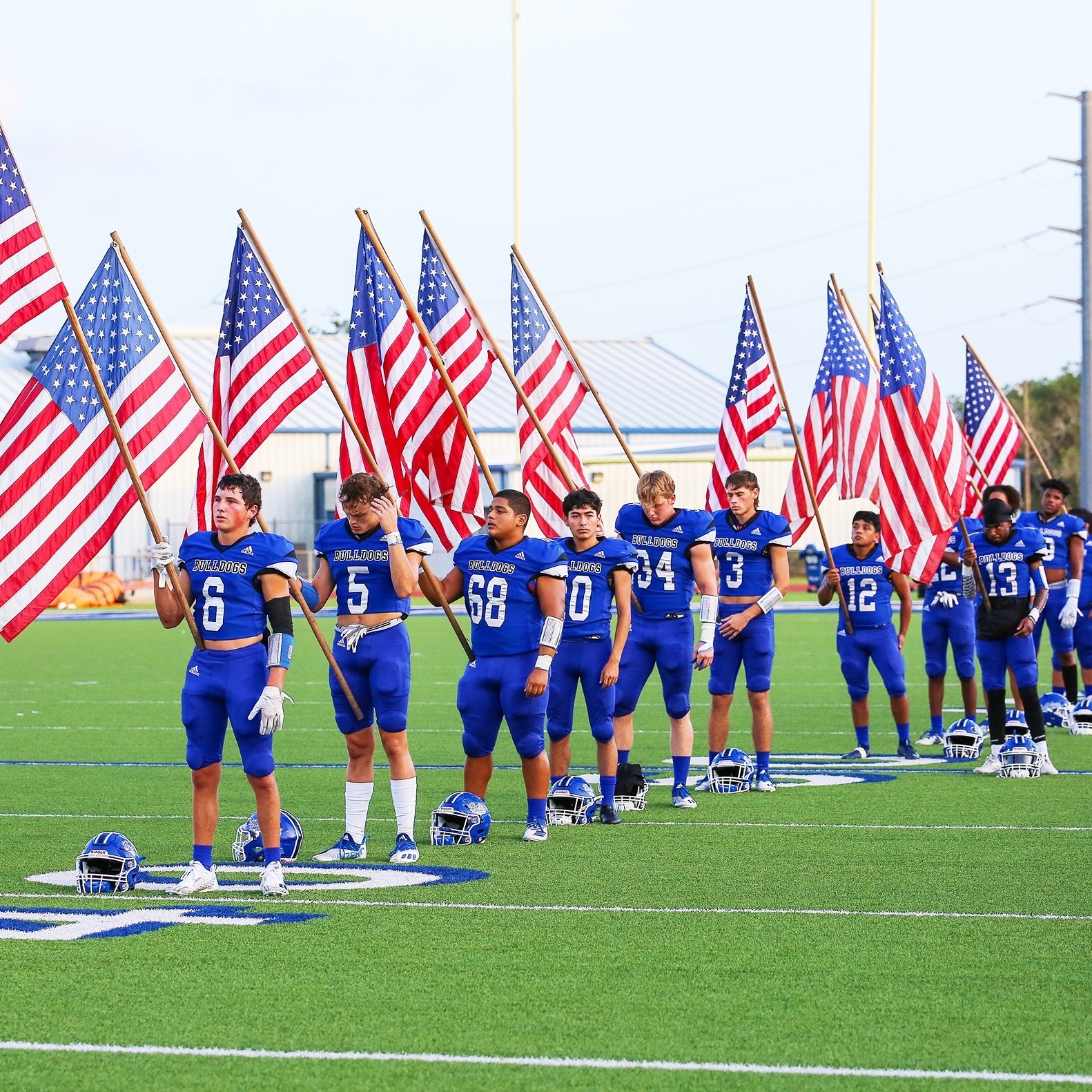
So, when George Bush finally greenlighted gatherings once more, saying we all needed to get back on with our lives, it was hardly a surprise to see the local stadium packed for the next game.
It wasn’t the least bit surprising, either, when that crowd’s voice thundered a resounding Amen following the night’s prayer for all those lost and still working those tragic events we’d all seen that Tuesday. Nor was it surprising when those voices rose once more in incredible unison to sing our national anthem. They must’ve heard us across clear across the county line, I thought.
But no sooner did the final notes sound—“and the home of the brave”—two fully-armed military fighter jets swept past our stadium. The cheers from the crowd made that National Anthem performance sound as if we’d all whispered it. And man, I thought, who in this town has that kinda pull, to orchestrate a military flyover as we sing our national anthem at a football game. That’s just incredib—
At just that moment, something else appeared in the sky, too. A tiny prop-driven plane, way off in the distance, not unlike the type that regularly filled the sky around El Campo, spraying rice fields and cotton crops. Thing was, though, the skies were closed, part of nation’s mandatory closure of the air space that occurred just moments after all those passenger planes started aiming at our nation’s landmarks.
The crowd saw it, too, by then, and what had been a jubilant, joyful group, moments before, fell pin-drop quiet, all our faces pointed up at the sky, everyone holding their breath and watching as those jets circled back to that little single-engine plane, again and again, motioning for the pilot to land. The jets flew right up beside him, seeming to come to a dead stop in the sky, then they’d blast off again, circling round to do it once more.
My thoughts flashed to my infant son back home, born just that June, and what sort of world I’d brought the little guy into. It was as if all our worst imaginings had come true. We were a target, and here was that no-name terrorist come to collect. All because we had things like hometown football games…
Turns out, it was nothing of the sort, I’d later learn. A longtime local pilot, enroute to an annual fly-in held in nearby Louise, had gotten some rather mixed messages about our airways when he took off from his private strip and decided to meet up with fellow plane enthusiasts a few miles away.
Not surprising, either, considering messages came in plethora about then regarding who was allowed in the skies. Mail and cargo got hauled by plane all the time, and it was already several days behind schedule at that point. Passenger planes were still grounded at the airports, but things like crop dusters would need to get in the air soon. Still, there was a healthy disagreement occurring over what types of planes and sizes might be allowed to fly, and who might enforce those actions. Of course, too, the military didn’t want just anyone up flying around, either. Not after everything that had happened that week.
So, acting on this get “back to your lives” speech given by the president, the pilot took off, thinking that none of the scuttlebutt floating about pertained to his tiny craft.
It was an honest mistake, it turned out, one that left that pilot well shaken when the F-14s showed up on his wing, for many days after he touched down.
At the same time, though, it was a moment that went from sheer exuberance one second to flat terror the next. I’ve never witnessed anything like that, prior or hence, that came close to being such an emotional rollercoaster, in such a short span of time.