
Blase’s Place celebrates 75th
Pulling the page from the protective plastic sleeve it lives inside, you know full well you’re handling a piece of history.
The paper it’s printed on long ago went yellow with the years, and the crease of its folds remains quite stubborn, not wanting to lie flat. And despite it being just a quarter century old, to the date, the day I happen to handle that particular news page, it seems so much older in my mind.
For starters, the page looks to be about twice as wide as anything we print on today. It’s from an era when they weren’t kidding when they called that thing a broadsheet, back before some penny-pinching newspaper publisher someplace came up with the brilliant idea to hack a good six inches off our pages to save a buck or two. Nobody will ever miss it, he surely must’ve argued.
Sure, buddy. Whatever you say
I’m immediately drawn to familiar faces there on the page—first in the photo on the page showing a rather dapper looking Blase Konvicka in one of those signature crisp white shirts of his, the ones he kept heavily-starched to make a nice sharp edge when pressed, and gleaming all the brighter with those dark slacks he always had on with it.
Beside him is his bride, Margaret, wearing a nice yet always conservative cotton summer dress. The two are standing out front of the store they both helped build to what it was. The page is dated Friday, Nov. 13, 1998, and the photo caption below them indicates that on that day, Blase and Margaret—or in my case, Uncle Blase and Aunt Margaret—are shown out front of their place, which they started precisely 50 years prior.
They are the day’s feature over in the Victoria daily, back when it actually was, and it’s filed under a regular feature the Advocate maintained for 30 full years they called Henry’s Journal, by columnist Henry Wolff Jr.
Having grown up with that newspaper in my household, his face is nearly as familiar as the relatives I have displayed there, and I’d be lying if I tried to say that reading his words growing up didn’t make me want to do this job. Truth be told, I wanted to BE him when I grew up, and in a roundabout way, I suppose I am, sort of… Just not so certain I ever quite grew up.
Sadly, everyone pictured there is no longer with us.
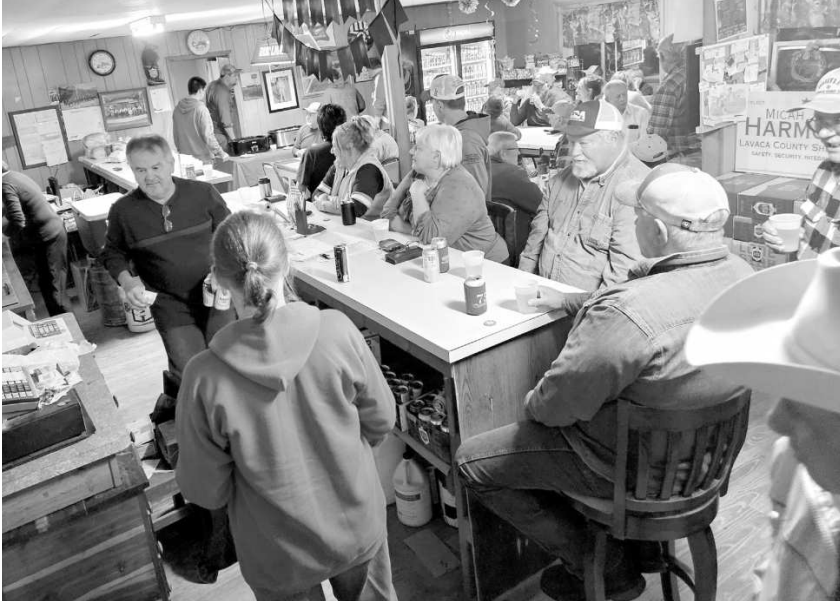
Still, seeing their faces a week ago, on Sunday, Nov. 12, handed to me by Blase’s youngest son, Mike, was a moving experience, indeed. Around us, the chairs, tables and barstools slowly began to fill as patrons steadily packed the place that Mike’s dad built with his own two hands, 75 years prior.
That was something I learned about my uncle just this year. Mike told me that in between his returning from the his Army service in the Philippines during World War II and him opening that store and, later, the nearby dancehall, Uncle Blase spent a few years out in Houston, making his way as a tradesman—a bricklayer, no less—that’s one of the hardest, most physical jobs imaginable on a construction site, even today still. Hardly the job I would have ever imagined him doing, but for three long years as soldiers returned from out in the world and began to flock to Houston for the many plant jobs that opened there soon after, he built their homes, one after another.
Until he’d had his fill and finally returned home.
Rather explains those pressed white shirts he always wore, at any rate.
Still, when I say he built the place up with his own two hands, I mean that quite literally. Scanning through the column Mr. Wolff wrote 25 years prior, he noted how the rains always brought in the domino players, boosting his business especially.
Most of those players he references are long gone as well, though there is a fresh new crop of them who still gather to fill their seats at the table, even if most of those “new crop” domino players are pushing 80 years of age or older now.
He brings up another fact in his column that I remember well from my younger years: How the Czech language was once about all you heard from the folks who walked in the store.
Today, you’ll still hear a word or two, every so often. But it, too, has become more of a novelty—a bit like that talking deer head Mike has hanging on the wall—compared to how it used to be, it is, anyway.
To ring in the occasion, Mike and Sandy, his wife, along with their four kids, Mikayla, John, Derek and Kevin, whipped up a delicious stew meat supper and invited all their patrons to help themselves, as they made their rounds filling drink orders and visiting with those who kept the place running all these 75 years.
Even the Dallas Cowboys on the television seemed to remember those good old days and dished out a healthy tail kicking to the Giants of New York. It was the first game I’d seen in years.
As Sandy put it, just before they offered up grace for the meal, “You’re all like family to us.”
What the future may hold when it comes to the store is anyone’s guess, really.
Unlike Mike, who literally grew up in the store— “We all had jobs to do, even before we started at school,” Mike recalls of him and his brothers, James and Blase Jr., as boys. Blase’s Place celebrates 75th While his brothers left the farm and store work behind them once they moved out with families of their own, Mike said, “it was always just understood that I’d work the store one day.”
None of his four kids have shown a similar interest in the store their grandfather started. When he gets to where he can no longer run it anymore, Mike said he wasn’t sure what may come of the place, other than it be a bridge they cross when that time comes.
All that’s certain is this: Things will change. They always have, and they always do. I mean, nobody’s stopped for haircuts at Blase’s in decades now, though for years they were about as common as stopping there for gas or a cold one.
Similarly, Eric Konvicka, James’ son, mans the dancehall these days. He and his family having put in a lot of work sprucing up the place in recent years.
And while Mike still fields occasional calls about the hall over at the store, most people have adjusted to the changes made, slow as they seem to come at a place like theirs, which for most customers these days, they’ve never known that particular stretch of Highway 90A without a Blase’s Place.
Wrapping up his column, 25 years ago, Mr. Wolff shared a few notable events and price tags of various items. It’s how I’ll leave you today, dreaming of 12-cent gas, nickel soda waters, and two beers for a quarter.
Other notable events in 1948:
• Columbia Records unveiled the 12-inch, 33⅓ LP (long playing) at the Waldorf-Astoria Hotel in New York City. The LP allowed listeners “to enjoy an unprecedented 25 minutes of music per side, compared to the four minutes per side for a standard 78 rpm record.”
• Baseball legend Babe Ruth died of cancer at the Sloan Kettering Cancer Center in New York City. “For two days following, his body lay in state at the main entrance to Yankee Stadium, and tens of thousands of people stood in line to pay their last respects. He was buried in Hawthorne, New York.”
• Communist rule was established in Czechoslovakia “after a nearly bloodless coup took place.” Up until that time, Czechoslovakia had been the last democracy in Eastern Europe.
• Honda Motor Company was founded in Japan, while Americans saw the advent of NASCAR, the Hell’s Angels motorcycle club, and evening televised news broadcasts.
• The height of technology: Americans could buy the very first portable tape recorders, transistor radios and televisions (though by year’s end, just 44,000 homes in the United States had a TV).
• The United Nations established the World Health Organization (WHO). Israel declared its independence as a Jewish state, sparking the first Arab-Israeli war. And North Korea was established as a communist state under Kim Il-sung.