

Hallettsville Garden Club meeting
A very interesting Comprehensive Study on Wildflower Seeds was presented at the Oct. 19 meeting of the Hallettsville Garden Club by Sharon Harrigan. Wildflowers attract hummingbirds, butterflies and pollinators. The fall of the year, ideally by the end of November, is the best planting time. Historically, wildflower fields were started by fire and bison trampling down the grass. Wildflower classics for a sunny yard are Indian blanket, Lemon mint, Mexican hat, Texas bluebonnet, Prairie coneflower, Cowpen daisy, Huisache daisy and Winecups. Shade yard wildflowers are Purple coneflower, Pigeonberry, Blue curls, Pitcher sage, Turk’s cap, Texas baby blue eyes, and Blue mistflower.
Most wildflowers sprout on their own but the harder seed varieties can be helped by rubbing with sandpaper or by freezing for a few days and then pouring boiling water over them and sitting overnight to puff and absorb water before planting. Try to plant seeds no more than twice as deep as the seed is wide. You don’t want to mow or clean area until flowers are seeded out. Enjoy pollinators the flowers attract.
Some favorites for spring planting are larkspur, poppies, dill, phlox, bachelor buttons and alyssum.
An awesome program was presented by Brazos County Master Gardener Robert Martinez on Heirloom Bulbs. These are bulbs that date back before 1973. He gave us some historical background on several bulbs.
The Byzantine Gladiola, introduced in 1576, is hardy in the northern part of Zone 6 and looks more like an orchid than a gladiola. The true stock is almost impossible to find. What you get today is some inferior imposter. Its corms have been found in farm fields as deep as 18 inches, well below frost level.
The St Joseph Red Amaryllis is hardy and bears a cluster of fragrant flowers with a white strip in the center of every petal. It’s reported to be introduced in 1799 as the first hybrid amaryllis ever recorded. It’s more tolerant of heavy clay soils and cold than other amaryllis. Blooming in the middle of lent, it has been reported to have gotten its name from St Joseph whose birthday is March 19.
The Oxblood Lily or Schoolhouse Lily is a deep red lily common in certain parts of Texas. A botanist, Peter Henry Oberwetter, a German native, migrated to Texas in 1849 and traveled through the Hill Country collecting and crossbreeding the bulbs.
The Red Spider Lily blooms in late summer atop a naked stem. The foliage appears later. Legend has it that this flower made its way to the Southern gardens when Commodore Matthew Perry took a 6-month trip to Japan in a paddleboat with 1600 men, and opened Japan to American trade in 1854. He brought back 3 bulbs to North Carolina.
Other lilies talked about were the Giant Prairie or rain lily found in Mexico, Texas, and New Mexico and the Crinum Lily or Milk and Wine lily, an extremely tough lily bringing up several spikes giving a month of blooms.
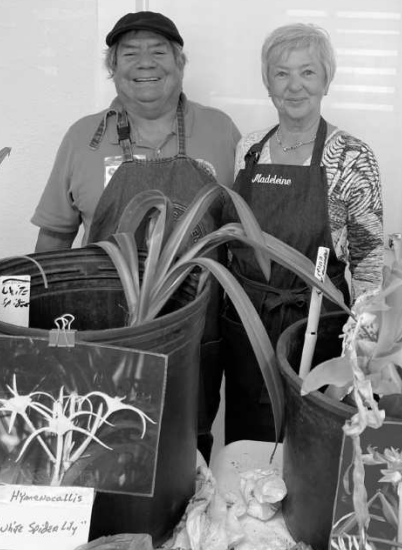
Mr. Martinez and his aide Madeleine Kissinger brought several of the different varieties of bulbs for members to purchase. He also stirred up a mixture of common items like pepper flakes and dish soap to brush on plants for deer resistance.
The Hallettsville Garden Club has many interesting programs presented by Master Gardeners and other gardeners that specialize in certain varieties of plants. If you are interested in the beauty of creation, please them,
The Thought of the Day was given. Hostesses Sandy Llewellyn and Lois Henry provided refreshments.
Janis Muehr, Recording Secretary