

Meteor shower anticipated from world famous Halley’s comet
Of course, if the clouds clear, there's the distinct possibility that the moon will get in your eyes
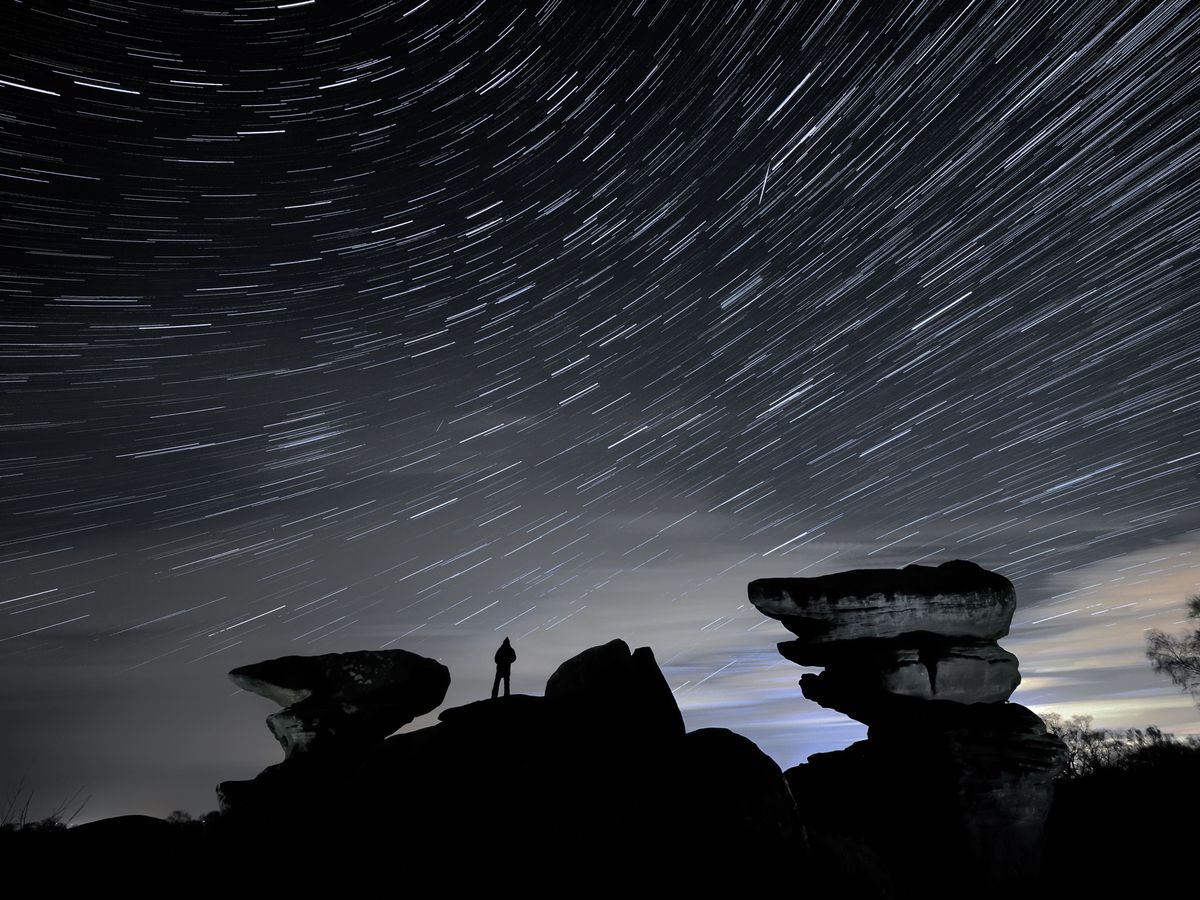
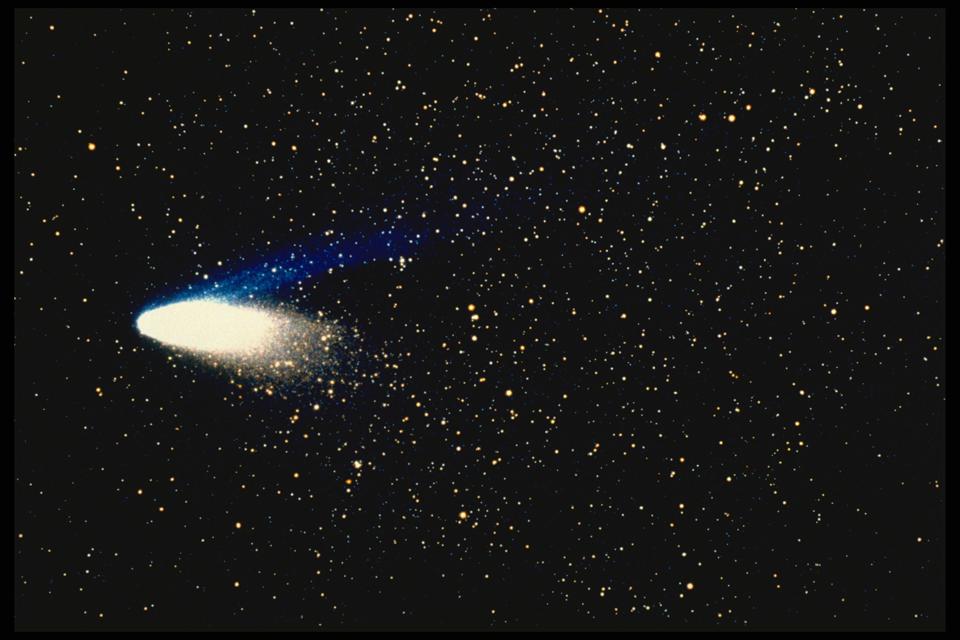
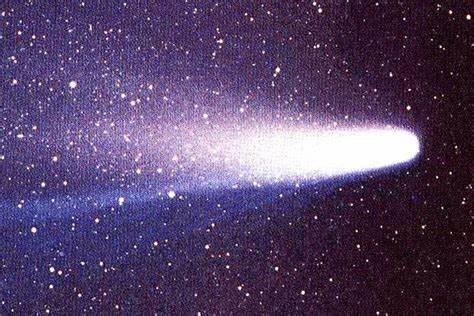
Today marks the peak of the Eta-Aqaurids meteor shower, an annual meteor shower caused by the world’s most famous comet, 1P Halley.
That’s according to national news stories published earlier this week by Forbes senior contributor Jamie Carter, a science and astronomy specialist.
Still, that doesn’t mean that Halley’s comet—named for the English astronomer who plotted its orbit in the 17th Century—is returning to the solar system this week.
It orbits the Sun every 75–79 years and was last seen in 1986. That was 37 years ago, but that’s a magic number for one of the least reflective objects in the solar system.
It’s how long it takes to travel to and from, between the Sun and the outer solar system. In fact, on Dec. 9 of this year, Halley’s comet will get as far as it ever does from the Sun—about 35 Earth-Sun distances past the orbit of Neptune—before it begins to drift back towards the Sun. Astronomers call this point the comet’s aphelion.
Currently in the constellation Hydra, “the water snake,” Halley’s comet will next be visible from Earth in the summer of 2061 when it’s expected to come much closer—and, therefore, be much brighter—than it was in 1986.
Halley’s comet’s two meteor showers
Its remains across our inner solar system remind us annually of the periodic presence of Haley’s comet.
Both May’s Eta-Aqaurid (also spelled Aqauriid by some, Carter says) and October’s Orionid meteor showers are caused by dust and debris left in the inner solar system by Halley’s comet.
Both are named after the constellations that the “shooting stars” appear to emanate from. They can, however, be seen anywhere in the night sky.
However, 2023 is a bit different. Unfortunately, on the same date—Friday, May 5, or Cinco de Mayo, for many in Texas—is the rise of the full “Flower Moon.”
That’s not complete deal-breaker for seeing the meteors, Carter says, because this particular meteor shower is known for meteors with particularly bright wakes. It’s often possible to see with the naked eye a bright “shooting star” that appears super-bright for perhaps a second.
In a dark sky between 10 and 30 meteors are expected each hour during the peak of the Eta-Aquarids (though it’s the southern hemisphere that tends to see higher rates, Carter says), but given the position of the Moon there’s little point in finding a dark location.
How to photograph the Eta-Aquarids meteor shower
In addition to knowing a thing or two about stars and planets, Carter is also a photography specialist for Forbes.
“Perhaps the best way to get a glimpse of a bit of Halley’s comet this year is by using a camera,” he says. “Put a DSLR or mirrorless camera in your backyard and have it take a series of 30-second exposures and it may pick-up a bright “shooting star” or two. A wide-angle lens (14 mm or similar), a tripod, f/2.8 aperture and ISO 800 are recommended.
“Use infinity focus, fiddle with the settings until you have a good balanced image of the night sky that shows sharp stars (point it away from the Moon and its trajectory) then put your camera on continuous mode,” Carter says.
“Wishing you clear skies and wide eyes,” he adds.
The comet’s namesake
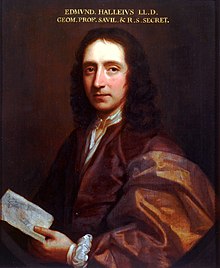
Edmond Halley (1656-1742) was an English astronomer, mathematician and physicist. He was the second Astronomer Royal in Britain, succeeding John Flamsteed in 1720.
From an observatory he constructed on Saint Helena in 1676–77, Halley catalogued the southern celestial hemisphere and recorded a transit of Mercury across the Sun.
He realized that a similar transit of Venus could be used to determine the distances between Earth, Venus, and the Sun. Upon his return to England, he was made a fellow of the Royal Society, and with the help of King Charles II, was granted a master's degree from Oxford.
Halley encouraged and helped fund the publication of Isaac Newton's influential Philosophiæ Naturalis Principia Mathematica (1687). From observations Halley made in September 1682, he used Newton's laws of motion to compute the periodicity of Halley's Comet in his 1705 Synopsis of the Astronomy of Comets.
It was named after him upon its predicted return in 1758, which he did not live to see.
Beginning in 1698, Halley made sailing expeditions and made observations on the conditions of terrestrial magnetism, and in 1718, he discovered the proper motion of the "fixed" stars.