
Part III: National Newspaper Week hits during trying times industrywide
Not an incredible lot of celebrating taking place with the passage of 2023 National Newspaper Week...
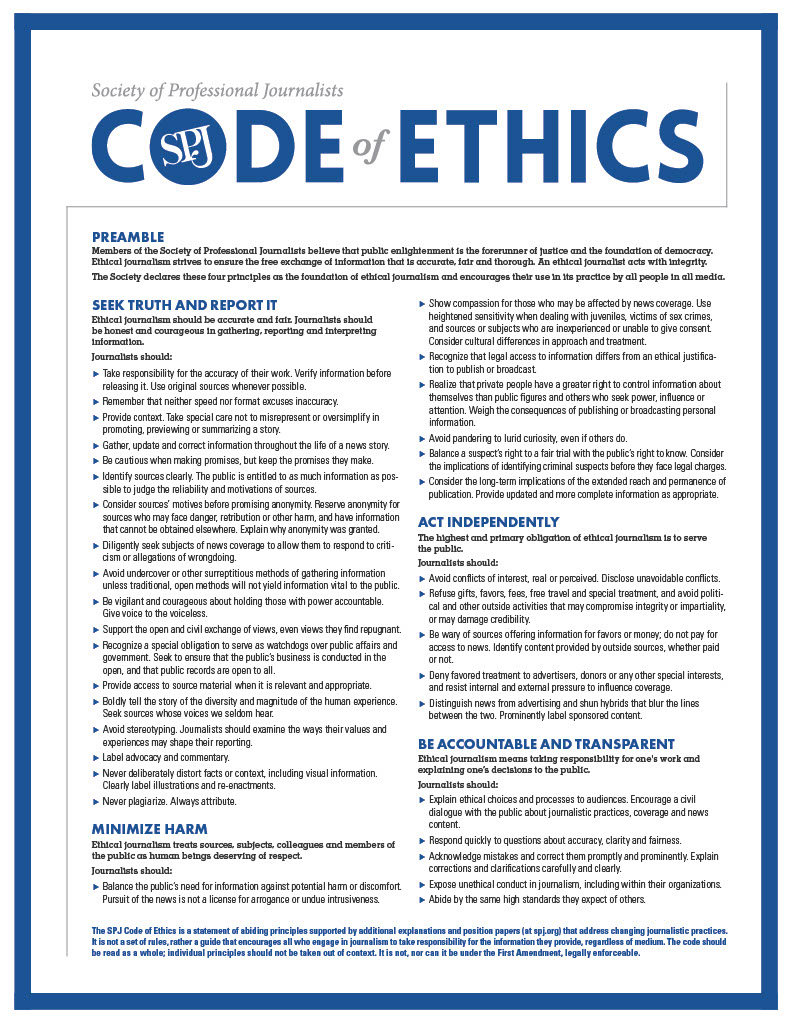
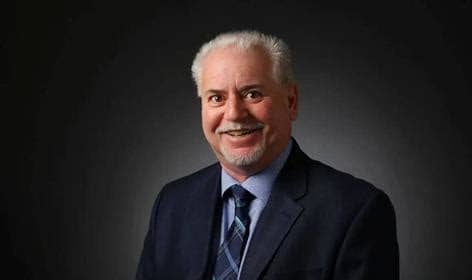
“The journalism industry is at a turning point, and I truly believe SPJ can position itself to build coalitions with like-minded journalism organizations in order to affect real sustainable change. We have to engage in policy discussions at the highest level. We have to produce research and reports that provide a more equitable way forward for the news business. Our very Democracy is at stake, and we don’t have the option to do nothing. I hesitated to join SPJ for several years because I just didn’t see anyone who looked like me in leadership positions. It made me feel like I didn’t belong in the organization. But I decided to be the change that I wanted to see in SPJ. Representation matters and I hope that I can show through my leadership and my diverse board of directors, that there is a place for everyone at SPJ.”
— Ashanti Blaize-Hopkins,SPJ National President
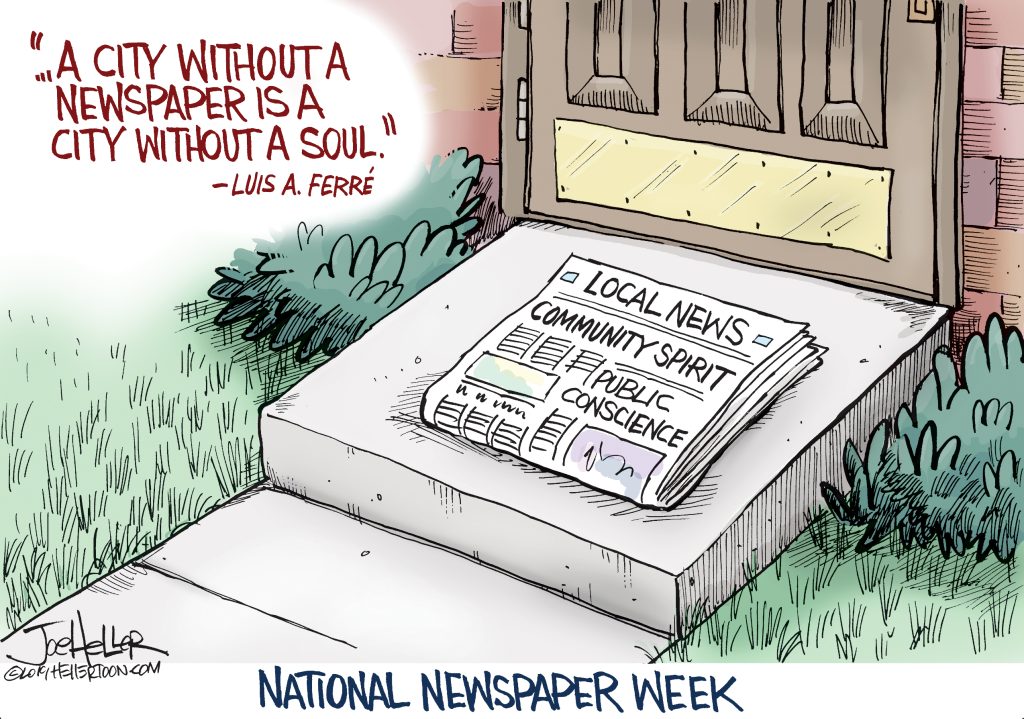


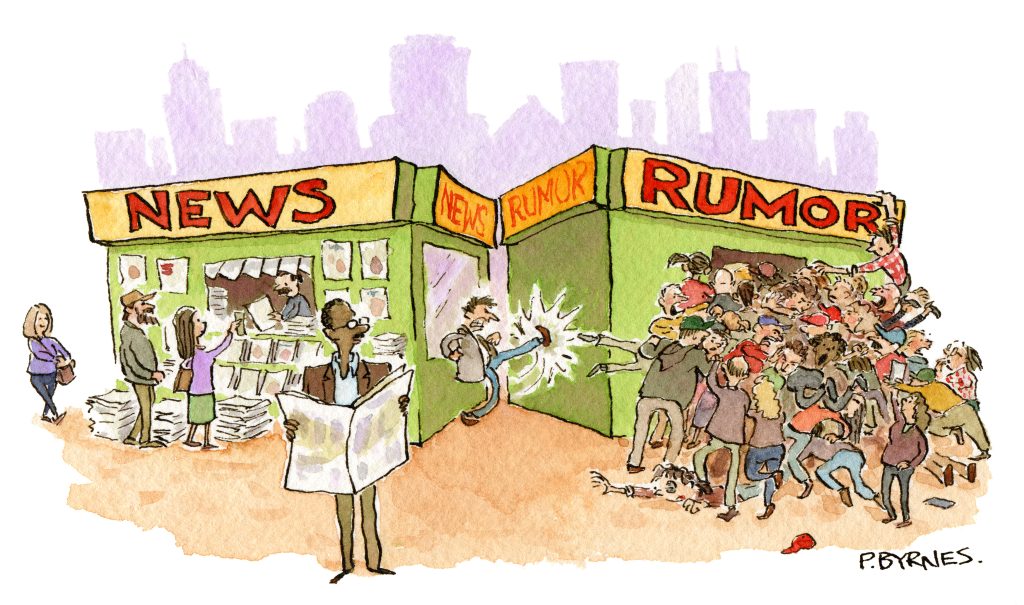

This year marks the 83rd celebration of National Newspaper Week. Since its inception in 1940, Newspaper Association Managers has sponsored National Newspaper Week, a week-long promotion of the newspaper industry in the United States and Canada.
Sadly, however, there isn’t a whole to celebrate in 2023, especially as we look at the multitude of issues facing a long-beleaguered industry right now.
Such as reports that Russian President Vladmir Putin’s national forces were purposely targeting journalists as they fall back from superior Ukrainian forces time and again, all while committing the oldest atrocities on citizens they happen upon in the paths of retreat.
They are the sort of crimes that truly war-torn regions always seem to inspire, especially among those tasting the bitter brine of defeat. To hide their sins, orders supposedly went out to kill anyone who looks like they're with the press.
That not only paints a target on every working journalist who ever set foot in those areas, but it speaks to a level of war crime that most western countries haven’t witnessed since Hitler’s goons roamed the countryside free and unchecked.
The same was true for Chinese reporters, who despite massive improvements in press freedoms over the past 30 years, now say their government grows more and more hard lined on such freedoms, the more they seem to ramp up militarily, and they’re not above brutality in driving that point home.
Meanwhile, reporters who remained in many North African and Middle Eastern countries following the U.S. troop withdrawal have utterly disappeared in those largely Taliban-controlled areas. Some haven’t been heard from in months now, and no one’s sure where to even look for them.
‘…both foreign and domestic. . .’
 Journalists here at home are anything but immune to the sort of attacks their counterparts face in other parts of the world.
And it involves much more than the cries of “fake news” begun by the former President Donald Trump before he rose to that office, yet a full two years after he left it, still resounds loudly from our most hallowed halls in Washington to our smallest communities, a thousand miles away.
Take the mysterious killing of Las Vegas reporter Jeff German, found stabbed to death in his home after he published a couple articles about alleged mismanagement and hostile work conditions found in one of his county offices. When Robert Telles was arrested on the suspicion of his murder—the same Telles who was accused of said actions by his own employees—eyebrows definitely went up, but not near as much as when his defense attorneys filed subpoenas against German’s newspaper, demanding they hand over any information they had that might shed light on the slain reporter’s confidential sources, which according to the defendant’s lawyers, could offer a key line in Telles’ defense.
That request was under review by the state’s highest court earlier this week to see if private attorneys truly can make such demands of the press, which flies in the face of a long-upheld reporter’s right to keep private his sources, even when compelled to do otherwise by various judiciaries. Such matters had always fallen under the constitutionally protected rights of free press because if you’re not at liberty to choose what it is you divulge, then a notion a free press begins to murk up quickly.
Mind you, the party who extended such protections in this case took said information to his grave, but now his boss, if he even knows anything, might be compelled to hand it over to the very fellow he was protecting his source from begin with, no less. Does that really make a lick of sense to anyone?
Still, the case remained under Nevada court review as this story was written, garnering the attention of several state and national press organizations, who believe that any ruling that nullifies the longstanding protected source standard could serve as the death knell to journalism as we know it.
And in a town smaller than Shiner…
An apparent spat with a local restaurant owner ended with full on raid of the local newspaper office and the publisher’s home by the local police department in Marion, Kansas, a town with fewer residents than Shiner.
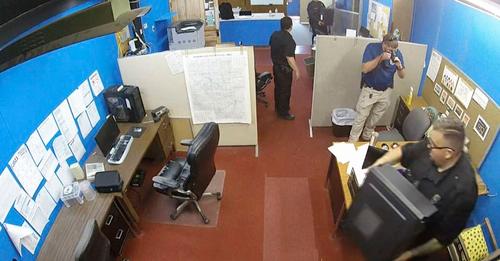
There, using vague and questionable warrants at best, officers seized every item in both the news office and publisher’s home that looked like it could possibly connect to the internet—including every computer, monitor, printer, router, television screen, cell phone, camera, even a postal scale and fancy calculator from the bookkeeper’s desk, some old bag phones they found boxed in a closet, and some medical devices found in the publisher’s home that officers could not quite identify for their inventory list— all on press day, no less.
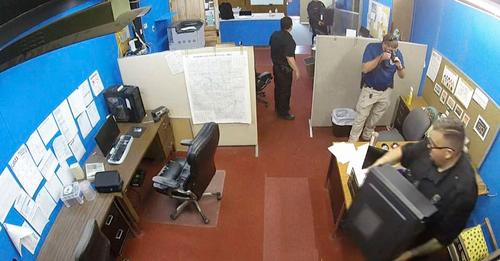
That publisher Eric Meyer’s 98-year-old mother and business partner, Joan Meyer, visibly shaken by the intrusion of several officers into her home, died the very next day after the raid, only exacerbated the situation.
So, what prompted all this?
Recently hired Marion Police Chief Gideon Cody, reportedly acting on rumors that Meyer might be digging into his past—Cody left his previous PD post by another town with nary an explanation as to why—apparently joined forces with the local diner owner to secure a warrant and execute the subsequent seizures based on what sounded like flimsy grounds for an investigation.
The diner owner, just weeks before, booted the publisher and one of his reporters from her establishment—with Chief Cody at her side, of course—because she felt they were too liberal to provide fair coverage of their conservative political gathering.
She presently accused Meyer of invading her privacy by publishing details about her past DWI conviction, which Chief Cody and full power of his office then backed up by seizing all newspaper’s equipment. All part of his investigation to prove or disprove her privacy claims, of course.
Mind you, the only details shared in the paper involved statements she herself made at a public meeting—which Meyer had recordings of, like many reporters often secure for accuracy’s sake—about misdemeanor DWI she landed.
She accepted her guilt in that offense once a plea bargain was struck that adjudicated her crime, provided she didn’t break any other laws for the duration of her sentence.
Apart from driving each day with a suspended license, we’re only to assume.
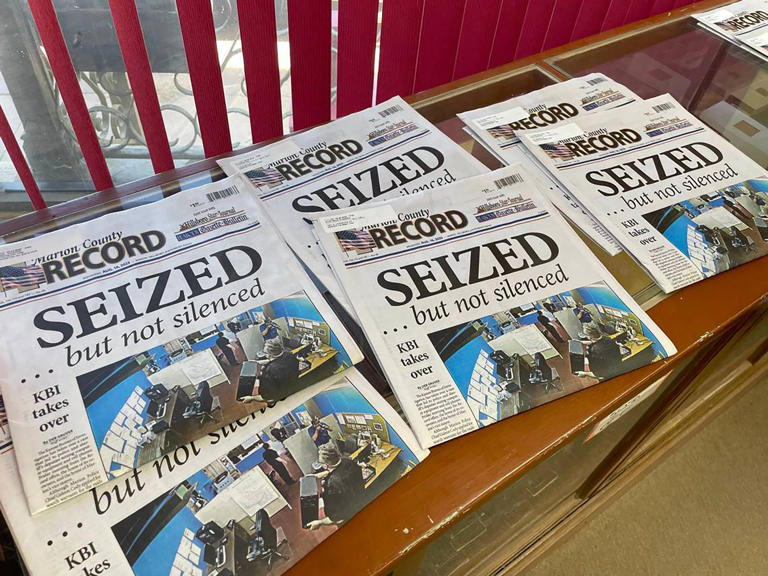
Despite all that—losing every computer he owned and dealing with funerals—the next week’s paper still published, the story of the raid completely covering Page 1, complete with images from the office’s security cameras of eight police officers hauling away computers and other items, with a bold headline splashed across the entire page that read “Seized but not silenced.”
Not only that, but the courts have since ordered that Chief Cody give back every item he took from Meyer. What’s more, he resigned his post with the department, having been suspended during city’s investigation into the matter.
Somehow, just walking away from that one doesn’t seem like it might satisfy all those who took keen interest in that particular case when it happened.
Amazingly short memories…
Some the nation’s largest, most influential press organizations were calling the August raids in Marion some of the most egregious violations of the First Amendment ever witnessed in these United States.
Which I felt truly terrible for Mrs. Meyer, too, but “most egregious” they’ve “ever witnessed…” Really?
Mind you, these are the same people who for months now cried foul after reporters covering the many demonstrations in the wake of 2020’s George Floyd killing—reporters who allege they made it known they were, in fact, there on assignment and not taking part in the riots—faced extraordinarily lengthy jail stays and harsh treatment by police in some parts of the country.
Like the reporters in Detroit and Pittsburg, who claimed that despite separating from the crowd, doing exactly as officers ordered, and holding up their press credentials for all to see throughout the ordeal, officers still beat them severely with night sticks, smashing expensive cameras, before they got hauled off to the local precinct and incarcerated for days, never once being charged with a crime.
Or the reporter, who despite standing on the opposite side of rather large, multi-laned Cincinnati street, credentials plainly displayed around his neck as he photographed protestors, attacking officers with bottles and rocks, the reporter was somehow shot in face with tear gas cannister fired from a gun.
That photographer may never see again out of his right eye, we were told. The same eye that he used in view finder of his camera, as someone who earned his living taking pictures with that very camera.
If that wasn’t bad enough, the reporter said his shattered camera finally got returned to him after nearly two weeks in the hospital where he underwent two painful facial surgeries to repair the damage the canister caused to his jaw and cheek bones. Thing is, every smidgeon of shattered glass and cracked plastic was accounted for. Every smidgeon, that is, but the SD card inside it that held all his images.
That somehow came free from one of the few places on that busted up camera that seemed to escape damage, and simply could not be located.
But such things will happen, right?
Timing is everything
So, in terms of “celebrating” National Newspaper Week, I’d tend to think that might be a poor choice of words, especially considering job prospects for those in journalism have never been worse, ad revenues are at historic lows, and costs couldn’t be higher.
And not just for writers, reporters, TV producers, radio station news directors or publication editors, but for every occupation those enterprises once supplied jobs for, from photographers, graphic designers, and marketing reps to press operators, accountants and the army of carriers who once manned the distribution efforts at even middling-sized newspapers.
 It was felt industrywide, too. While we’re still losing local newspapers, big outfits like CNN and NPR have cut news staff. In 2022, the two largest Spanish-language television networks, Univision and Telemundo, saw their audiences drop. Even the Texas Tribune, who successfully pioneered the nonprofit business model that many viewed as the last saving grace for a struggling news industry, announced their first-ever layoffs within their ranks in August.
Just one fact is certain: If you want to read bad news about journalism, it isn’t hard to find.
There’s plenty out there. It was a fact I came to know all too well in grad school when I was rather appalled to discover that an entire nonfiction genre had cropped up since I last frequented a library. It dealt with rise and fall of the great American newspaper, but mostly the demise part. It was literally nonexistent in 2005. But starting in 2006, the titles would flourish, one atop the other. Understandably, for that’s when some of the very first widespread job cuts hit home, and later, when several more than century-old newspapers closed their doors one last time, creating the first of what they would call “news deserts” around our country.
By the time I first discovered It, hundreds of books had been published on the subject. It was astounding how many there were in such a brief span of years. In addition to chronicling the final days of wherever they might be, most also gave some truly blistering self-criticisms in their quest to answer the big why behind it all. Let’s face it, we journalists earned at least some of it through mismanagement, laziness, outright arrogance, or just plain naivety.
I remember how we all embraced the internet like it was the second coming back when, when it first made its arrival in a real way in the late 1990s. How all the old fogies who told us we were shooting our feet off, giving the milk away for free like we were.
But what did they know? Other than everything, we all came to realize soon enough.
Especially when sites like Facebook and Twitter broke into the scene, making instant millionaires of the kids who dreamt them up, and systematically gutting our industry from the inside out in a matter of months.
Incidentally, in all those so-called news deserts that have cropped up around the country in the years since, government corruption and overstep has flourished, according to studies led by groups like the
Just last week some 500 members of the Society for Professional Journalists, once the nation’s oldest and largest press organization in the country and a leading voice for media advocacy, held its national convention in Las Vegas. Like most such organizations, the conventions serve as a place where they decide organizational priorities, choose their leaders, present their awards, and provide a whole host of discussion round tables, training sessions and the like to inform, educate, share and sometimes, simply entertain those who have gathered. Lord knows after what this industry has been through these last decade or so, we could use some levity.
One of its first orders of business? Canceling next year’s convention as a cost savings measure.
They had to, you see, for in one of the biggest points on the immediate horizon, they were longer the largest press organization. For the first time in more than a century, it officially fell from its top seat. By a lot it turns out. Investigative Reporters and Editors claimed the top seat in 2023 with more than 4,600 members nationwide. Affinity organizations like the National Association of Black Journalists and National Association of Hispanic Journalists also have around 4,000 members each.
SPJ has 4,136 current members — down from the “nearly 10,000” members at one point — and just 2,246 of those are professional members. (The total figure includes 812 student members, 338 retired members, and 317 non-journalist “associate” members.) The loss of membership dues alone is anticipated to leave something like a $391,000 deficit in their finances.
Given the drastic cutbacks that nearly every newsroom has faced in recent years, it’s rather ironic that a group like IRE, with its emphasis on investigative journalism, should become the largest of news organizations, now, considering that investigative, in-depth journalism is almost always the first thing to go when the cuts start. Still, that same factions we see among some of the other top groups nationally today mirrors what society have been doing during that same timeframe.
That we may all be journalists suddenly becomes secondary to the fact we’re black journalists, or Hispanic journalists, or white journalists, for that matter. Of course, there was a time when newsrooms picked up the tabs on such memberships, especially among managerial sorts. It wasn’t terribly difficult for people to sign on to every membership form that slid across their desks. Such days are long gone, however, and since we now foot those membership bills ourselves, one has to pick and choose his affiliations much more carefully.
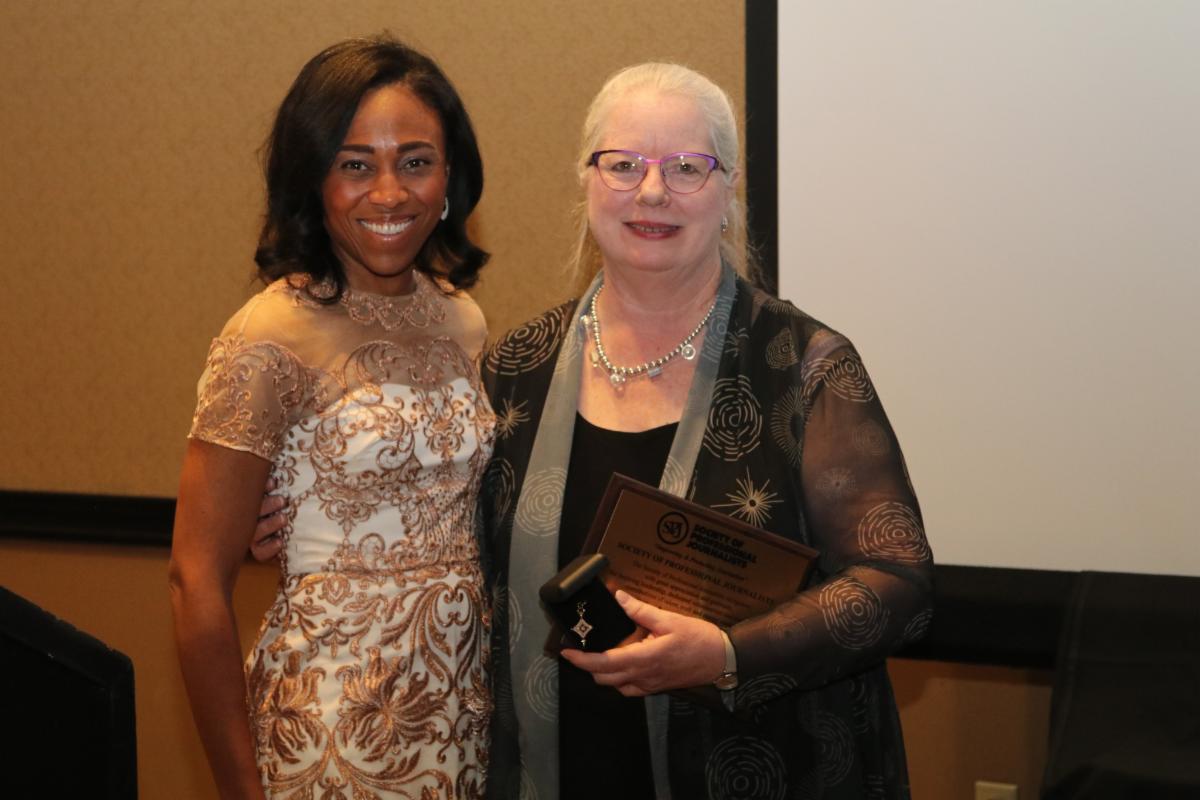
So it went, then, that when they swore in the 107th SPJ national president last week, it was Ashanti Blaize-Hopkins accepting the oath. She’s a former TV news anchor and reporter who today serves as a journalism professor at Santa Monica College, where she is also the faculty advisor of the institution’s award-winning student-run newspaper, The Corsair. While she may be the 107th SPJ president, she is also the very first black woman to ever serve in SPJ’s top post. She replaces Claire Regan a lifelong reporter and editor from New York.
Still, SPJ’s treasurer Irael Balderas probably summed up the situation best in an interview he gave to Sarah Scire, deputy editor of Nieman Lab for journalism at Harvard University:
“If we don’t change our thinking,” he said, “our next incoming president could well be our last president.”
A rather stinging assessment, no doubt. But one can only wonder how many times sentiments just like those sounded in the board rooms of all those now-shuttered newsrooms found across our country, just before the locks went up.
Bringing it all home...
As someone who has seen his words in print for what’s getting closer to four full decades with each passing year, I’ve maintained an on-again, off-again membership with SPJ since the late 1990s, thanks in large part to one of my early editors being a member. You see, one of the tricks I learned early on was that if I ever hoped to improve my skills as a writer, I needed to read stories by writers who were better than me. Trust me, that’s never been hard for me to find.
And contest winners offer a ready crop of stories for young writers to do that still each year, from regional press award winners, like the West Texas Press Association Gulf Coast Press Association or South Texas Press Association, to statewide contest winners found with the Texas Press Association or the Texas Associated Press Managing Editors Association, to national press award winners (of which there are a plethora) and one of the best among them I soon learned, was SPJ’s Sigma Delta Chi Awards.
So, for years, they became one of my regular reads each year, and it paid off, I think, because for a full 20 consecutive years in my career, I was a perennial award winner in every one of the markets I published. Little weeklies, large semiweeklies, dailies, and even monthly periodicals. I wound up with more awards than I can recall anymore, and most now collect dust on the walls of newsrooms past. For while your work may have garnered the nod, it was the publication which claimed the award.
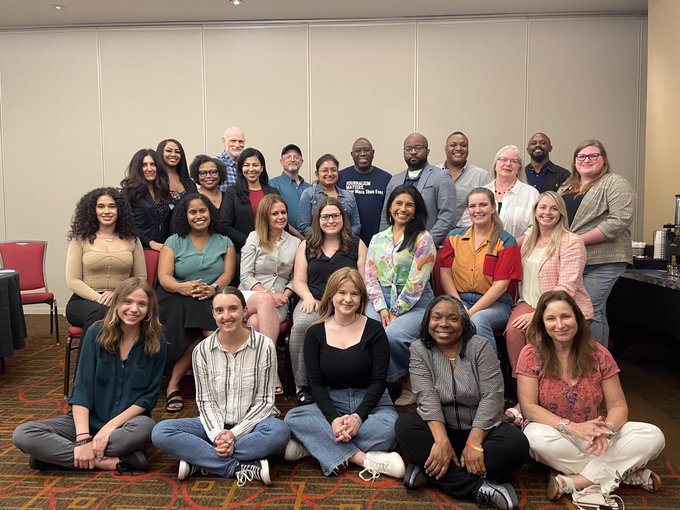
So, after all that, you can well imagine my surprise when SPJ smiled my direction and announced in late June that I’d been selected one of just three Texas journalists, as one of just three Texas journalists and 21 nationwide to be chosen to their Future Leaders Academy, which was held July 21-23 in Indianapolis.
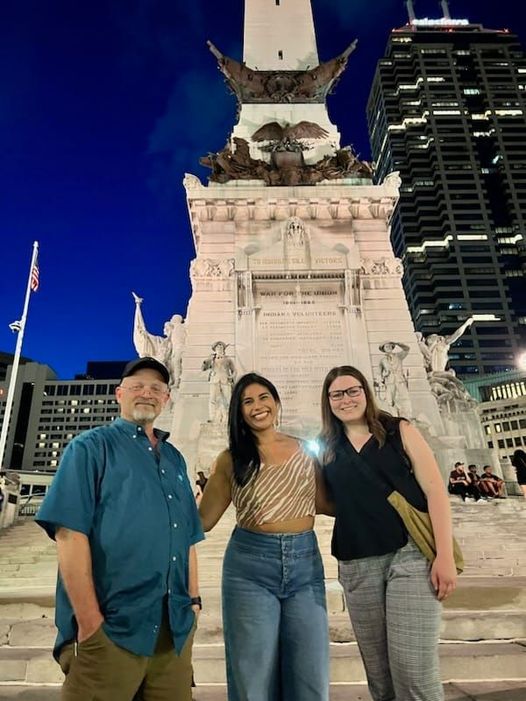
And as one my suspect of something like this, part of my weekend conference focused on personal development and self-enrichment sessions, but a good many more of our talks that weekend focused on many of the very topics I’ve highlighted in this article thus far—the ever shrinking newsrooms, the financial constraints we all face especially since covid essentially shut the world down, our ever-growing news deserts around the country, training up the journalists of tomorrow, and the flat-out attacks that even here in little Hallettsville, I’ve definitely been no stranger to—and what we might do on even a personal level to try and combat those.
I was completely out of my element, the entire time. For starters, I could’ve fathered about half of the people in that room. Despite that fact, we had a couple Pulitzer finalists among those 21 in attendance, several Sigma Delta Chi Award winners—one fellow, barely 30-years-old, already had two of them to his credit—not to mention Peabody Awards winners and a bunch of other broadcast and academia awards that don’t pretend to know a thing about. Almost everyone there had a book or three to his or her name, and I’m fairly certain that was the absolute longest time I have ever spent in a room full of Yankees.
Sadly, there are no magic answers for any of it, nor are there any ordinary answers, either. Of course, none of us expected there to be, either. If somebody even came to such a thing, they’d be selling it for low, low price just $4,999.99 a man—that is the American way, after all—and there would be those who would likely give it a shot until somebody called it scam.
When it came to answers, those were for us to sort out. It’s why they brought us all together last July: In hopes that we might pool our respective talents to find some way forward, collectively. Now, of course, those things that may work well in the heart of nation’s capital or on the streets of Philadelphia or New York City would likely be no more effective here in rural South Texas than our conservative, small town ways would be welcomed there.
Still, the fact we were all talking and sharing perspectives with one another is a lot more steps the right direction than any of us were headed individually before all this, I think. There was a whole crowd of people in Indianapolis, for instance, who couldn’t mention the topic border security without a healthy eyeroll. It’s not terribly hard to imagine why, either. We here in Texas couldn’t help smiling just a bit the first time our governor shipped his first busload of illegals over to Vice President Kamala Harris’ house. There comes a point, however, when any amount of cleverness that act may have once held begins to smack of sadism just a little, and it probably came well before he shipped some 42,000 people to points unknown since just last year. Albeit that’s a fraction of what crosses into our back yards regularly, but it ain’t like an American authority figure is shipping here by the busload either.
At the same time, however, nobody was rolling eyes they heard a story about a certain late night in Lavaca County back in 2021 when what should’ve been a traffic stop suddenly became a high-speed car chase to the middle of nowhere that had an abrupt ending with a mighty oak. Those who could ran leaving eight people behind who didn’t fare so well when their ride went from about 110 mph with the cops closing into a dead stop assisted by that tree. Soon after, we eight people, banged up bad, trapped inside a burning truck with the closest fireman or paramedic about 20 miles away. It ties every law man, EMS crew member, fire, everybody for an hour or more. Heaven forbids any of us who lives here has a heart attack or something, because we’re going to have to wait until this bunch of yahoos who did this to themselves gets taken care of. What’s more we’re going to get eight expensive ambulance bills that we’re going to eat. So, not only might we die waiting for that ambulance that never arrives, but we also get to pick up the tab for that fiasco as well. Then, next week, we get to do it all over again with another group, someplace else.
It was the first time that about 20 mighty fine reporters had ever even heard story anything close to that one. “Why hasn’t someone put together a numbers study on that?” I was asked.
The short answer: Because I have five newspapers to put out each week, and if I happen misspell hamburger in a school lunch menu by accident, I get to field a week’s worth of phone calls from people who dial me up for no other purpose than to show me how much smarter than me they are.
Plus, it’ll take work, lots of it, more than I have the manpower for. I passed it on as a project for one of the nonprofit groups. They, too, realize this is a major project, one that involves numbers that it so happens state open records law specifically protects when to comes to people’s personal records.
And their slates are filled with projects until about 2037.
So, we send out another bus instead.
Sure, it makes us look like a bunch of racist cowboys. But we’re from Texas. We get called worse than that before breakfast, most days. We figure its on account of how jealous folks are that we get to live in such a beautiful place.
And I learned a thing or two myself, have taken the many riots of 2020 as little more than just that riots. Senseless actions that destroyed property and threw down an even greater divide between the many factions we already had in the country -black-white-Hispanic-young-old-cop-not cop... and what good did it accomplish? Not one damn bit. In fact, things are about as bad now as they've ever been. Until, that is, I heard about that photographer in Cincinatti, a fellow about my age, who had covered the world with that camera of his, who may have had his career ended by some young cop playing cowboy with the artillery, who probably make that shot again if his life depended on it.
I didn't meet him personally but felt as though I connected with his story, shared with by a close friend of his, one of my fellow attendees. For everything that poor guy endured, they really didn't have to take his pictures, too, but whatever.
Because honestly, we all tend to get tunnel vision and not see beyond our own little worlds. I know I do, anyway. Sometimes, you must get outside your comfort zones to clear that perspective a bit. That, or you wind up burying your head in your own little world and basically say screw everybody else.
Which works fantastic, until your office is getting raided by local police out of spite and petty personality conflicts one day.
Or our face gets shattered by teargas cannister one day, stealing away your means of livelihood along with your eyesight.
Or, after you take one for the team in the most serious way, you get to know, just before you breathe your last, that the guy you went to your grave protecting is as good as dead now, too, because the lone fellow you shared all this with, your editor, is now required to fess up thanks to that case in Vegas.
So, there is that. But much like Balderas said of the new SPJ president:
We must change how think. Or even something our days of National Newspaper Week—celebrated or otherwise—are surely numbered as well.
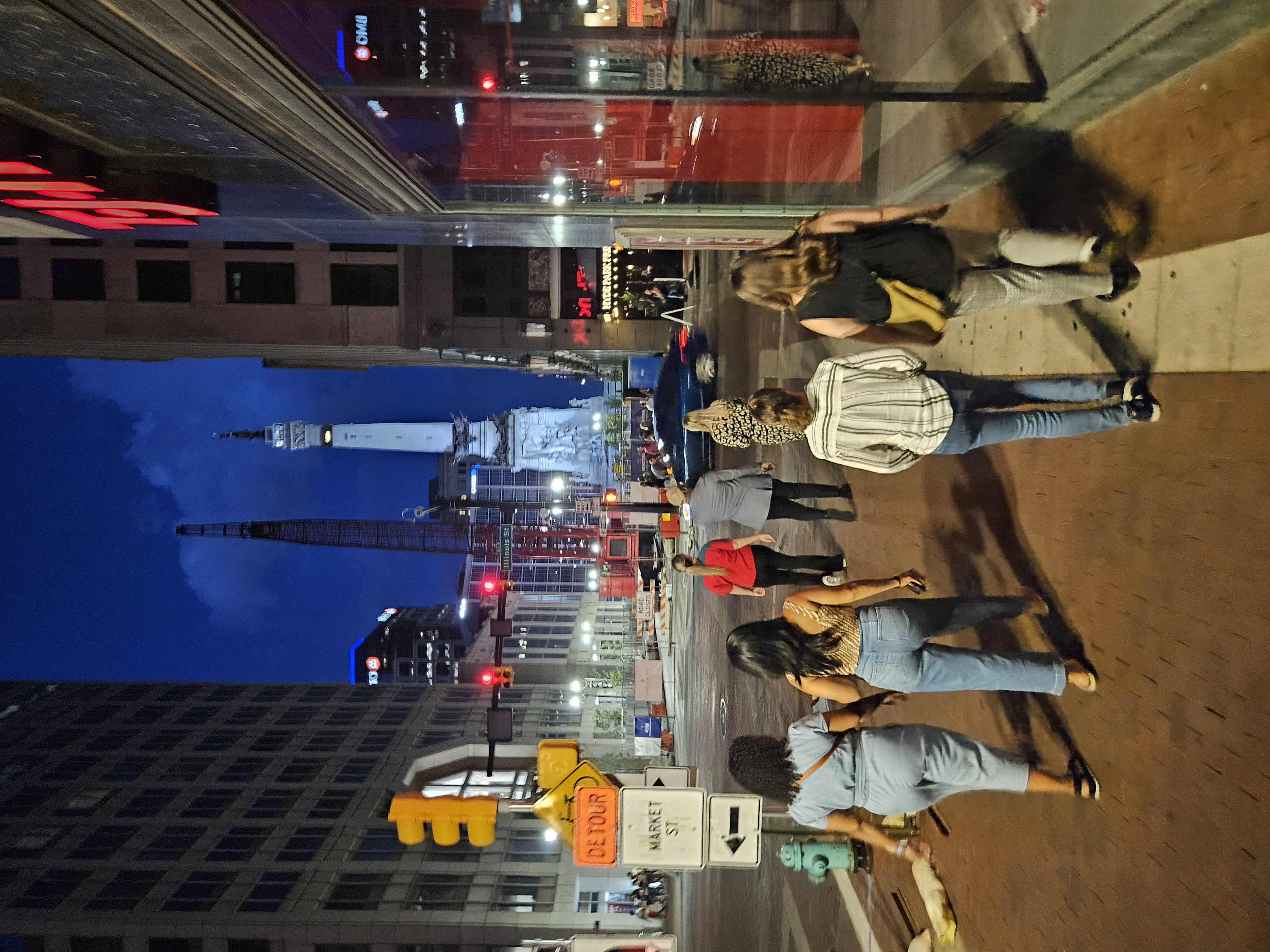
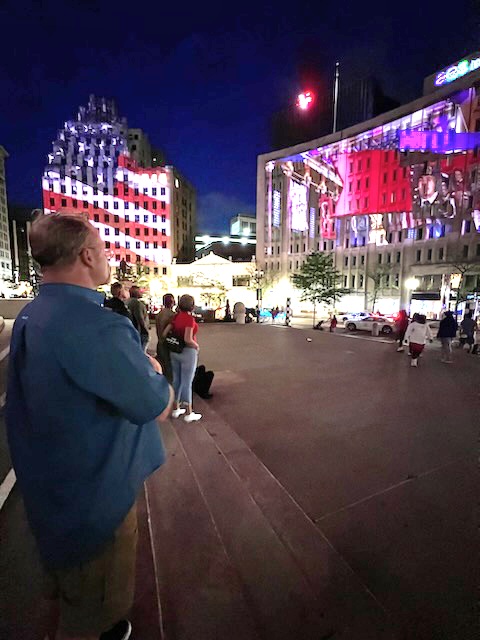
Downtown Indianapolis on our group's final night of the conference.
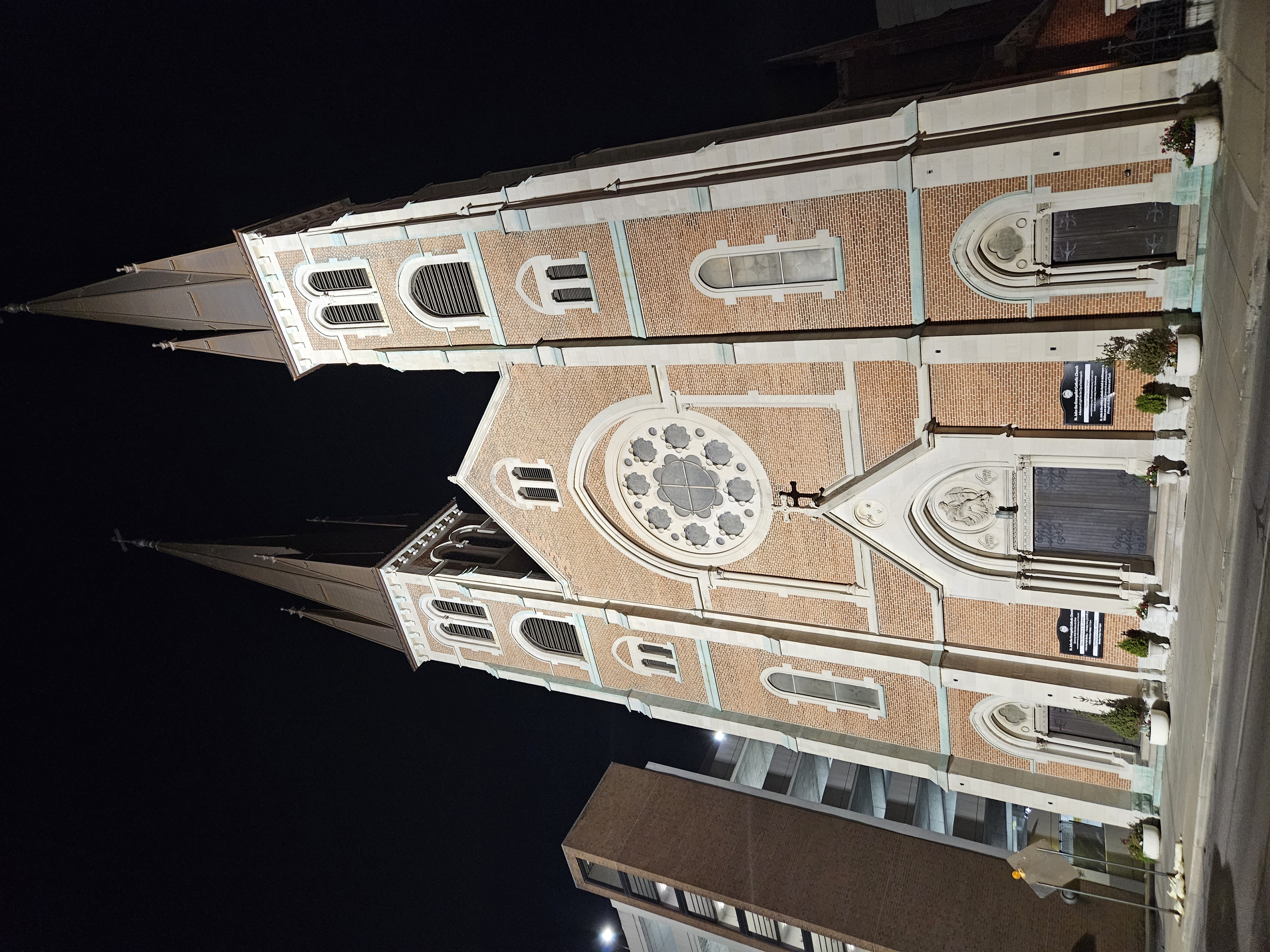
The Indianapolis Catholic Church...
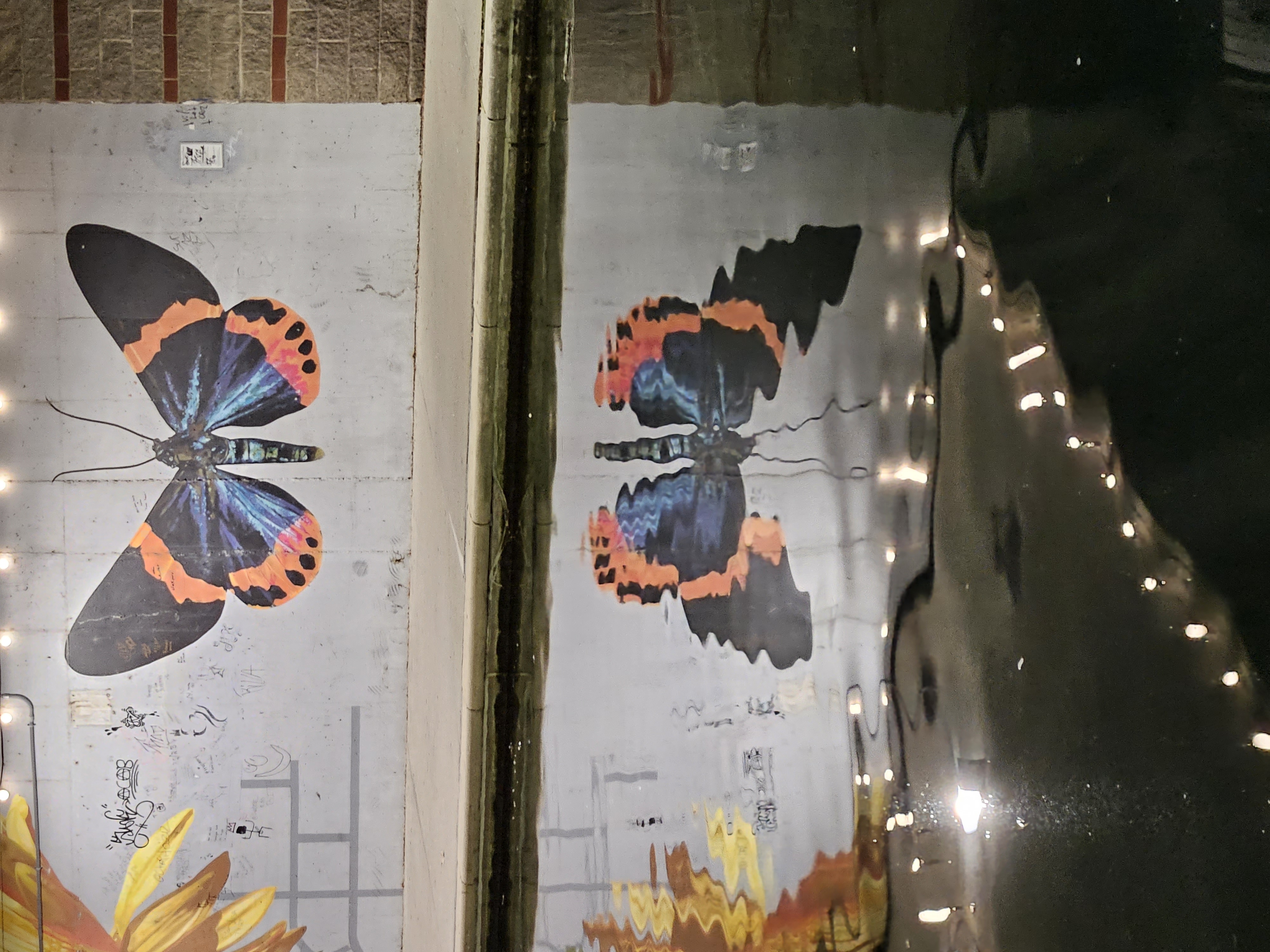
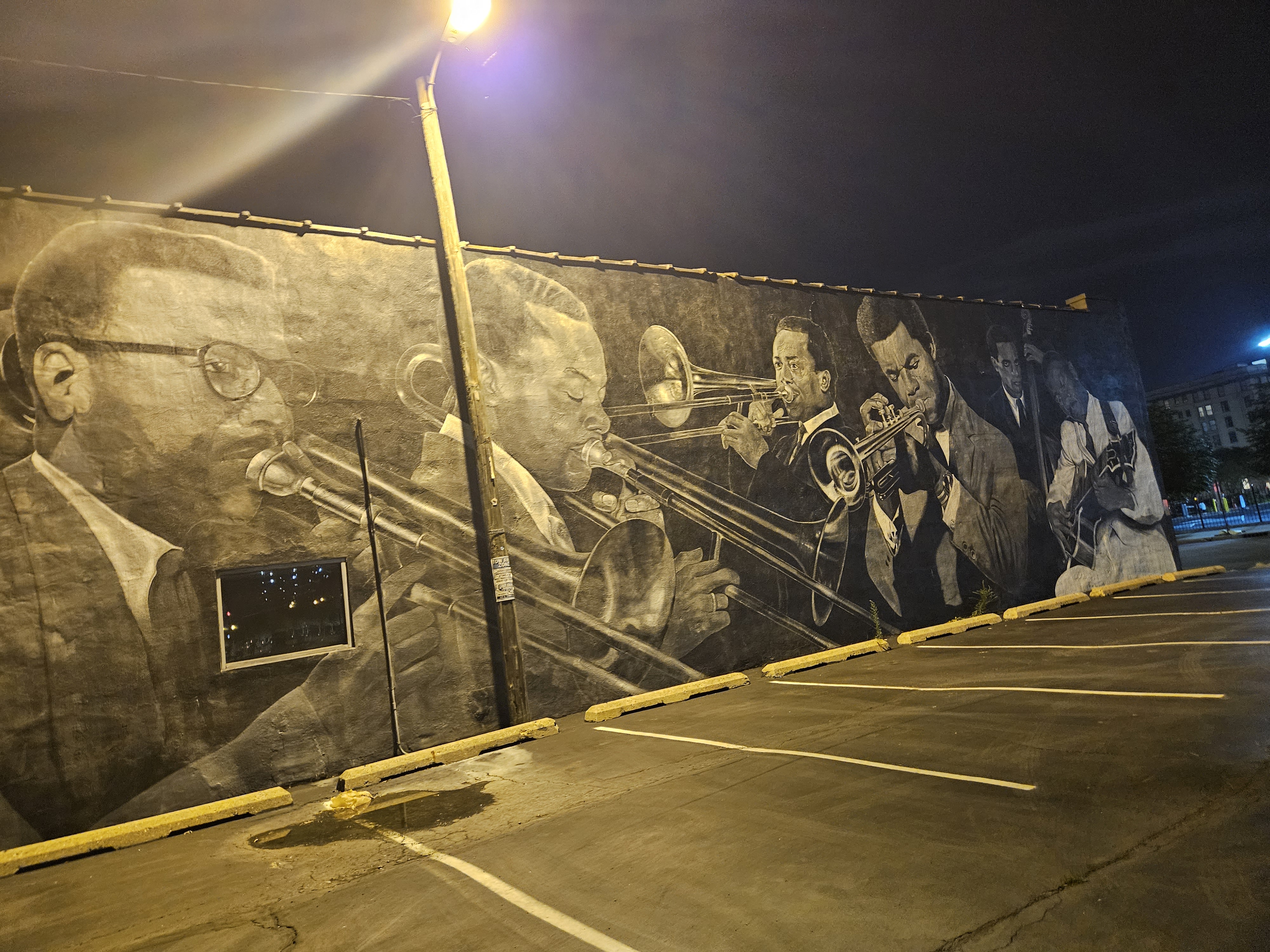
One of many works of art found in Indianapolis, reflected off the waterways of the city.