
A whole bunch of questions about the Statue of Liberty, the real one, that you probably never thought about but might be glad I did…

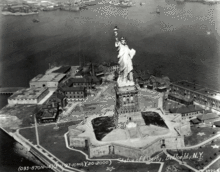
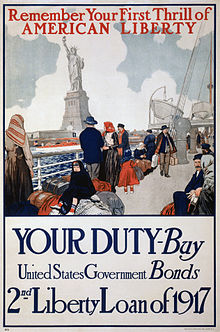


Q: How did we get the Statue of Liberty? What’s its significance?
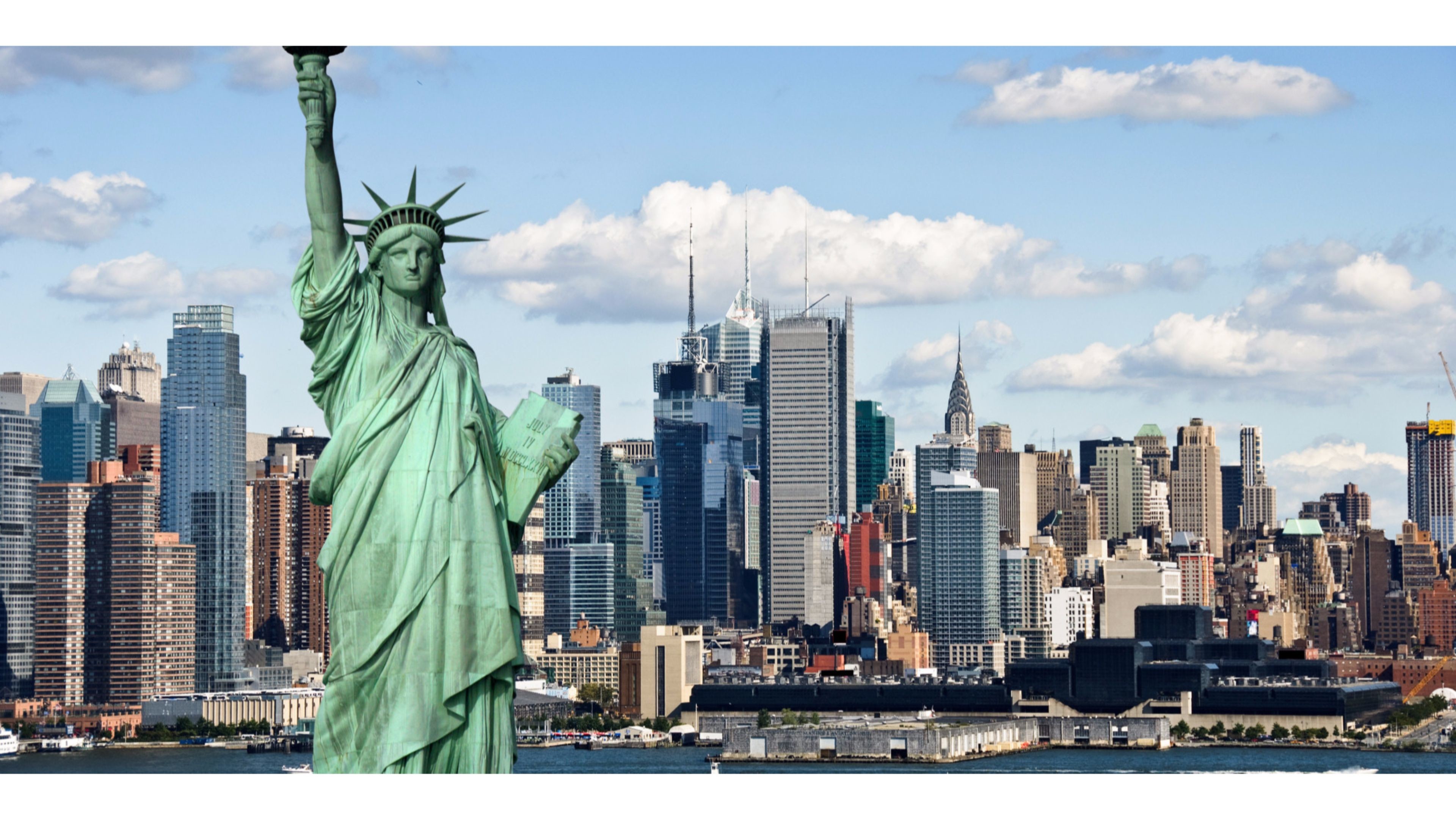
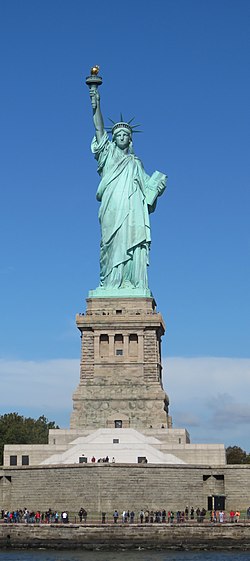
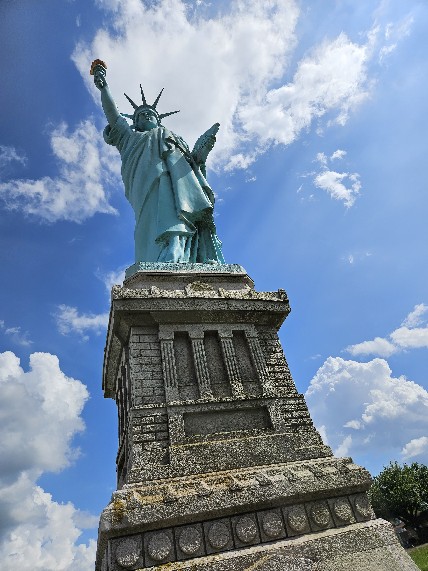
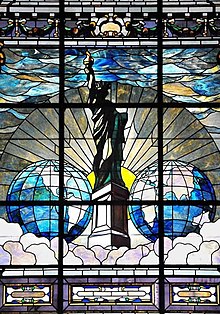
A: The statue was a gift from France to the United States in the 1800s, a token of friendship from one country to another. Often referred to as Lady Liberty, the statue was dedicated in 1886 and was recognized as a National Monument in 1924. It still stands today in New York Harbor.
Q: What is written on the Statue of Liberty?
A: There are actually two inscriptions on the Statue of Liberty: One is on the tablet Lady Liberty holds in her left arm, and the other is on a bronze plaque found within the pedestal of the statue, which was added later.
Q: What does it say on the tablet?
A: The Statue of Liberty holds a torch in her uplifted right hand and a tablet cradled in her left arm. The date of the Declaration of Independence is inscribed on the tablet in Roman numerals – JULY IV MDCCLXXVI — which is, of course, July 4, 1776.
Q: So, what does the bronze plaque on the pedestal say then?
A: According to the National Park Service, the most common quote associated with the Statue of Liberty is from a poem inscribed on a bronze plaque located inside the pedestal of the statue: “Give me your tired, your poor, your huddled masses yearning to breathe free.”
Q: And the words on that placard, where did they come from?
A: Turns out, the most famous quote associated with the Statue of Liberty was never part of the original statue gifted to us by France. Rather, those words go to a poem written by Emma Lazarus called “The New Colossus,” and they got added some 15 years after her dedication.
Q: So, the most famous words associated with Statue of Liberty were never there to begin with?
A: Well, yes and no. You see, although the Statue of Liberty herself stood an impressive 151 feet and 1 inch tall (46 meters), she also weighed 225 tons. Such weight required a substantial base, or the statue would have steadily shrunk until she was consumed by the sea.
While France informed us at our nation’s centennial, in 1876, that they aimed to gift us statue of colossal proportion as a token of friendship between our two nations, how we might set it up was our problem. So, Americans began working to solve its stability factor.
Several architects came up with ideas, each wanting their name tied to the project. What nobody talked much about was that the financial means to back the project was nonexistent. Only after several proposals were presented, each more extravagant than the one before, did finances get addressed.
Which is how, in 1883, promoter William Maxwell Evarts, joined by a writer friend named Constance Cary Harrison, contacted the poetess Emma Lazarus in hopes of persuading her to donate one of her poems to an auction of art and literary works to benefit the pedestal fund.
At any rate, the words of Lazarus’ poem were indeed there as Lady Liberty found her footing in America. They even played not so small a part in rallying a cause to support it. Sans that, Lady Liberty may well have moved elsewhere. But were those words part of the French gift to us? The answer, regretfully, is no.
Q: So, why her? Why not find some other writer, or an artist or something and simply move on?
A: Emma Lazarus picked up some early acclaim when her first book of poetry garnered high praise from Ralph Waldo Emerson, considered by many the nation’s top literary mind at the time. Despite that early success, many later works came off as “cosmopolitan,” technically right but “lacking in real distinction.”
Until, that is, a new wave of immigration, in 1881, saw the influx of millions from the Russian and Eastern European ghettoes. Lazarus, herself of sophisticate Sephardic stock (Spanish Jews), took up the defense of persecuted Jews and began extensive work for the relief of immigrants in our nation.
That shift in focus worked to make her a decidedly better writer, it turned out. Her next book release, Songs of a Semite, in 1882, was a big hit, especially among the Jewish elite who possessed the means to bed down this project’s financial woes, once and for all. So, Evarts and Harrison needed her.
If they were ever to pull this off, she had to be on board. They were essentially riding her coattails. That’s not likely the version she ever heard, but given their circumstances, it’s hardly improbable that something very much along those lines was likely discussed on the ride out to meet her that first time.
Q: How were Evarts and Harrison received? Did Lazarus just hop right on board?
A: She initially refused, which must’ve landed like an anvil. Still, her reasoning was sound: How could she possibly write anything worthwhile about a statue, much less one she’d never seen? So, when she came back later and handed them the words to “The New Colossus,” their hearts surely must’ve leapt.
Q: So, they got her, obviously. The Statue of Liberty indeed went up. Was it all they imagined?
A: Even with her help, that grand sale that Evarts and Harrison envisioned never came to pass. It only managed to raise a meager $3,000. That’s roughly $90,335 in today’s values, hardly chump change by any means, but still far short of the estimated $300,000 (or, about $9 million, today) that they needed.
Q: So far, it looks like we’re still about $297,000 shy here. How did they make up the rest?
A: They tried all sorts of things, most of which bombed even worse than that big art auction sale idea. They tried to pass a bill with the State of New York that would have supplied some $50,000 in funds, for instance. It sailed right through both houses, only to get vetoed by Grover Cleveland, state governor at the time.
Mind you, there were several people working to raise funds, so they were collecting bits and pieces, ever so slowly throughout the process. After almost a decade of fundraising, however, they still about $100,000 shy. Then they turned to Congress to cover the tab. That, too, failed.
You see, before Lazarus’ poem changed the meaning behind the statue, it was largely symbolic of the now slain Abraham Lincoln’s abolition of slavery in these United States. You see its designer, a man called Bartholdi—more on him in a bit—was a staunch abolitionist. That country of our magnitude would dismantle an institution like slavery deserved proper recognition and encouragement, he believed, and he got the French government to see as he did, so that by lauding abolition it might one end the practice of trading money for human flesh.
The Statue of Liberty was originally intended to fucus on just that, our liberating the enslaved black man in our country. Problem was, fresh out of the Civil War, you take a thing like that to Congress, and half the country was still sore on that point. And not so much that they enjoy owning people (though we’re certain indeed did) but more so their very lifestyle depended on it. They were farmers, after all—plantation owners, sure, but farmers at heart—they had slaves because they didn’t have tractors or cotton pickers or chainsaw or… any oof the modern conveniences that works to expedite such labors. And so long as they had slaves, they wouldn’t need such things. They had slaves, after all. When slaves are suddenly freed, just watch how fast technology will fly for things they employed in farmwork.
To say that an entire race of people might be viewed as little more than machinery could seem a rather harsh indictment to those who did the viewing. Others may say it’s way oversimplifying the issue. History shows us, however, that such was indeed the case.
Because it’s flat amazing how fast all such items begin to develop when suddenly all those labors fell to the white man to tough out by his lonesome.
But take that to Congress, about how wonderful it all was freed the Blacks, so we want to some astronomical sum to build this statue commemorating that day, and I’m betting most southerners at the time would tell you exactly what you could do with such a proposal. Fortunately, this a family-friendly website, so I’m not allowed to repeat such sentiments.
Lazarus’ poem began to cast a new light on the statue, and intended or otherwise, it was far simpler for a southerner to admit this America had done him well and likely would continue to do so for generations not yet to born, especially as more and more immigrants began arriving who began proper in this new world just as they had. It was a far easier pill to swallow for them, at very least, than remind them it was antislavery at every turn. Most of a diplomatic mindset embraced anything which might launch a new narrative.
It began to look like they may well lose it altogether until New York World publisher Joseph Pulitzer stepped forward to save the day. He would collect some 120,000 donations in all, most less than a dollar each, but over about a year, he managed to raise every cent and then some ($3 million-plus, today).
Q: That’s the second time that the statue “going elsewhere” was raised. Where would it have gone?
A: That’s a $10 million question on some game show right now, we’re certain. But it could have been anyplace, really. Cities can get outright cutthroat when it comes to competing for certain items, and places like Boston, Philadelphia and others were just praying New York’s plans would flop.
Although not likely, as we southern states were long admonished for our Confederate allegiances in the years following the 1865 surrender at Appomattox, but just imagine how Lady Liberty may have looked, poised off New Orleans at the mouth of the Mississippi. Or, at Galveston, Indianola or Corpus Christi Bay.
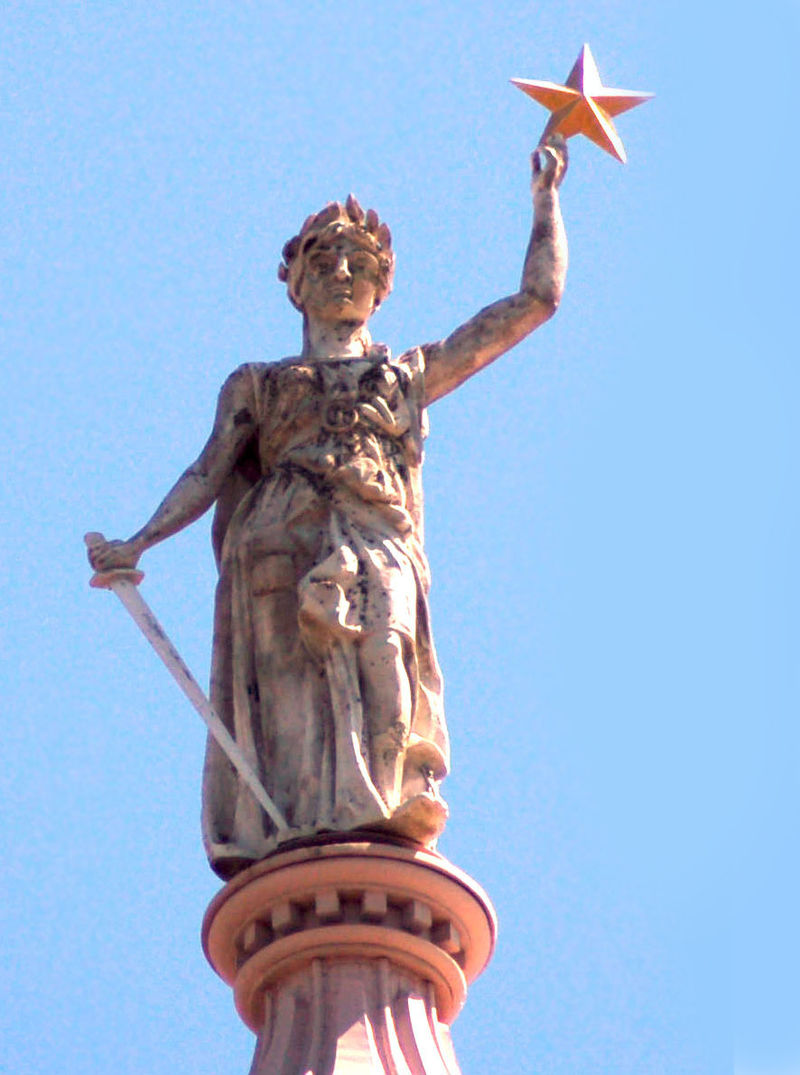
You’ve got to think, even today, in an age where things like 3D printers are no longer the stuff of science fiction, allowing us to create most anything we can imagine and then replicate it, ad nauseum, how many people still drive here each weekend, just to see the Hallettsville replica and snap a picture?
Q: Is it true that the sculptor actually started on this project some 30 years before?
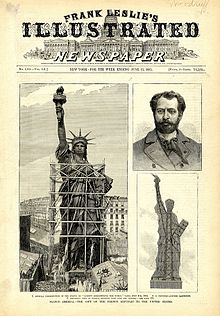
A: Although French sculptor Frédéric Auguste Bartholdi put a lot of design work into making Lady Liberty uniquely American, ours wasn’t the first country he tried to build a colossal statue for. Some 30 years before he ferried her across the ocean to our shores, he tried to market one quite similar in Egypt.
Like most classically educated people of his day, Bartholdi was likewise well acquainted with Colossus of Rhodes in ancient Greece. But that structure was long gone already. To satiate his interests in colossal statuary, he opted for where they still stood. So, he found himself in Egypt, land of the Pharaohs.
During the mid-1860s, Egypt had just finished the massive undertaking that was the Suez Canal, connecting the Mediterranean to the Red Sea, and with them, Europe to Asia, all as Bartholdi made his sojourns into Egypt to study their still-standing colossals, many in the town Abu Simbel.
Hearing of his interest in the subject, the Khedive of Egypt, Isma'il Pasha, sought an audience with him. The Khedive envisioned something not unlike the Colossus of Rhodes had been in ancient Greece: A massive, recognizable figure which guarded the entrance to its ports.
Plus, it doubled as a sort of lighthouse of sorts to guide ships into port, night or day. Unlike that structure, however, which depicted Helios, the Greek Deity of the Sun, Bartholdi had something of a more feminine nature in mind. He started putting together concept drawings and working up a proposal.
His was to be a statue of a robed female Saeid Misr or “Upper Egyptian,” bearing a torch at the northernmost entryway of the Suez. He even began shaping the copper plating he intended to use on the body of the statue to form up what he had in mind for her face.
A massive structure, the statue itself would have stood some 86 feet tall and be placed atop a pedestal that added another 48 feet to that, for an overall height of 131 feet. The Colossus of Rhodes, by contrast, was but a mere 108 feet tall. He strode into his meeting with the Khedive full of confidence.
Upon hearing Bartholdi’s plan and then hearing the price tag that went with it, the Khedive refused to hear any more. As if to ensure the plan would never have life, he commissioned that very year, in 1869, the construction of the Port Said Lighthouse, on the very spot that Bartholdi planned to build his.
So, by the time he began work on the Statue of Liberty, Bartholdi already finished several pieces of Egypt Carrying the Light to Asia, that even he said he later repurposed for Liberty Enlightening the World, or as she is better known, the Statue of Liberty, explaining the Egyptian features some say are seen in her face.
Q: So, what? He regifted Lady Liberty to us when the Egyptians did not take her?
A: In a manner of speaking, yes, as was not uncommon among many artists of the period. Repurposing canvasses, stonework and even completed works was often how an artist could continue to create until the means presented itself by which he might resupply his needed items, whatever those may be.
Q: So, $300,000 won’t even cover a modest-sized home these days. What did it get back then?
A: Well, their heavy-duty pedestal went up as planned, built by the lowest possible bidder, no doubt. But it has now stood a good 140 years since that statue first went up, and despite millions of visitors each year, rarely does one here about some repair at the base.
The statue herself, however, is another matter entirely. It’s undergone some sort of major maintenance or upgrade about every decade and a half, ever since it first went up. Constructed over the course of a decade in France, it got packed in more than 200 crates for the voyage and was then reassembled here.
With the base, the completed statue stands some 305 feet tall (93 meters). The base itself, constructed largely of concrete, is actually three feet taller than Lady Liberty herself. The completed base measured 154 feet from the ground to its top deck. The Statue of Liberty stands at just over 151 feet tall.
Rather than focus on Lady Liberty herself, Lazarus’ piece—a 12-lined traditional sonnet—instead compares it to the colossus of old, specifically the Colossus of Rhodes, a wonder of the ancient world until it got laid low by an earthquake, with ideals and values that a more version might be based upon.
It was a classical reference that sold well among the cultured and educated elite like herself. What truly set it apart, however, was inspired by the hardships witnessed daily working with oppressed, those who fled persecution where they lived, only to greet it, compounded tenfold, 000as strangers in a strange world.
Lazarus, you see, was unaccustomed to such scenes as those that now played out before her. She was mite spoiled, you might say, having grown up in a social stratum that sheltered such things from her eyes. Seeing them now made lasting and meaning impressions on both the writer and her words.
Not like the brazen giant of Greek fame,
With conquering limbs astride from land to land;
Here at our sea-washed, sunset gates shall stand
A mighty woman with a torch, whose flame
Is the imprisoned lightning, and her name
Mother of Exiles. From her beacon-hand
Glows world-wide welcome; her mild eyes command
The air-bridged harbor that twin cities frame.
'Keep, ancient lands, your storied pomp!' cries she
With silent lips. 'Give me your tired, your poor,
Your huddled masses yearning to breathe free,
The wretched refuse of your teeming shore,
Send these, the homeless, tempest-tost to me,
I lift my lamp beside the golden door!
The first two lines of the poem refer to the Colossus of Rhodes, a statue of the Greek god Helios, which stood in the city of Rhodes in Greece. This statue, which was about 107 feet tall, was one of the tallest statues in the ancient world and was considered one of its seven wonders. It was destroyed by an earthquake in 226 B.C.
At 151 feet tall, the Statue of Liberty is more colossal than the Colossus of Rhodes and stands not for conquering power as he did, but for welcome and hope. She tells ancient Greece to keep her “storied pomp” and give her instead, the tired, poor and homeless. Although the statue was not originally intended to be a symbol of immigration or hope, but rather a symbol of friendship between the United States and France, or an unshackling of its slaves, the sonnet on the plaque has forever changed her purpose.
Q: So, when did some of the largest waves of European immigrants make their way here?
A: Many date the Industrial Revolution to as far back as the invention of the steam engine in the early 1700s, but real change in how people live occurred much later.
While work went on in France on the actual statue, fundraising efforts continued in the United States for the pedestal, including contests, benefits and exhibitions. Near the end, the leading New York newspaperman Joseph Pulitzer used his paper, the World, to raise the last necessary funds. Designed by the American architect Richard Morris Hunt, the statue’s pedestal was constructed inside the courtyard of Fort Wood, a fortress built for the War of 1812 and located on Bedloe’s Island, off the southern tip of Manhattan in Upper New York Bay.
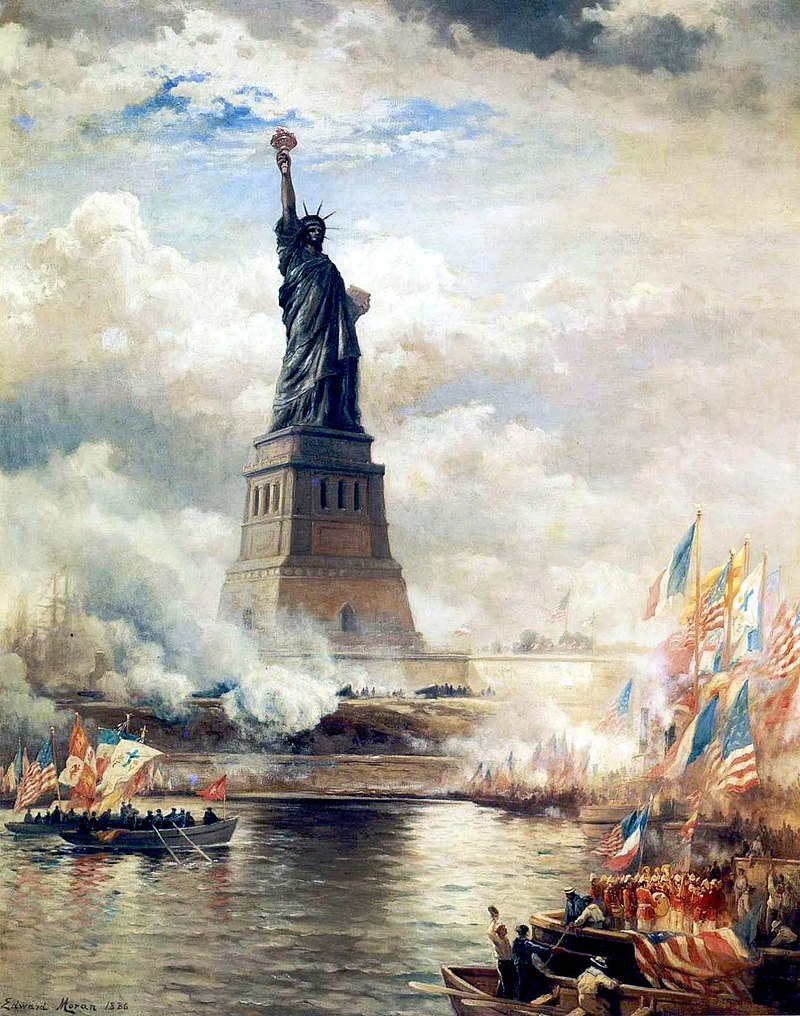
In 1885, Bartholdi completed the statue, which was disassembled, packed in more than 200 crates, and shipped to New York, arriving that June aboard the French frigate Isere. Over the next four months, workers reassembled the statue and mounted it on the pedestal; its height reached 305 feet (or 93 meters), including the pedestal. On October 28, 1886, President Grover Cleveland officially dedicated the Statue of Liberty in front of thousands of spectators.
In 1892, the U.S. government opened a federal immigration station on Ellis Island, located near Bedloe’s Island in Upper New York Bay. Between 1892 and 1954, some 12 million immigrants were processed on Ellis Island before receiving permission to enter the United States. From 1900-14, during the peak years of its operation, some 5,000 to 10,000 people passed through every day.
Q: What’s this I hear about women protesting the Statue of Liberty when she was first unveiled? What crawled up their skirts?
A: Believe it or not, skirts were precisely why they protested. Well, that and a keen sense of irony. You see, although immigrants would pass beneath HER shadows by the millions before all was said and done, not one woman had the liberty to vote or hold elected office at the time the so-called Statue of Liberty was first dedicated on the afternoon of Oct. 28, 1886.
As voter law was placed in the hands of each state individually, there are several different dates recorded as to women were granted the right to vote, but most agree that it took the first World War, or Great War as it was called then, before women were permitted to cast a ballot with any sort of regularity.
Here in Texas, suffrage ended in June 1919, when the law got changed allowing women to vote. In reality, though, it would be August 1920 before any saw an opportunity to exercise that right, a full 73 years after the first organized suffrage movement took place in the 1840s at a place known as Seneca Falls.
By contrast, former black slaves won the right to vote with Congressional passage of the 15th Amendment back in 1870. How many could exercise it was debatable, especially in places like Texas where the so-called Jim Crow laws and poll taxes prevented black votes until halfway through the 1960s. Still, an entire five decades passed between allowing blacks to vote and extending that same privilege to their wives and daughters. Fifty years!
So, no irony was lost when these same men were spending thousands and thousands on a supposed “gift,” that was little more than a big woman named “Liberty,” who for reasons they couldn’t quite fathom, were inventing all these alleged freedoms we all hand. Except those actual women who the refused to let vote.
Nore from Wiki:
President Grover Cleveland, the former New York governor, presided over the events held to dedicate the statue. A parade was held in New York City; estimates of the number of people who watched it ranged from several hundred thousand to a million.
President Cleveland headed the procession, then stood in the reviewing stand to see bands and marchers from across America. General Stone was the grand marshal of the parade. The route began at Madison Square, once the venue for the arm, and proceeded to the Battery at the southern tip of Manhattan by way of Fifth Avenue and Broadway, with a slight detour so the parade could pass in front of the World building on Park Row. As the parade passed the New York Stock Exchange, traders threw ticker tape from the windows, beginning the New York tradition of the tickertape parade
A nautical parade launched at 12:45 p.m., and President Cleveland embarked on a yacht that took him across the harbor to Bedloe's Island for the dedication. De Lesseps made the first speech, on behalf of the French committee, followed by the chairman of the New York committee, Sen. William M. Evarts.
A French flag draped across the statue's face was to be lowered to unveil the statue at the close of Evarts's speech, but Bartholdi mistook a pause as the conclusion and let the flag fall prematurely. The ensuing cheers put an end to Evarts's address. President Cleveland spoke next, stating that the statue's "stream of light shall pierce the darkness of ignorance and man's oppression until Liberty enlightens the world.”
Bartholdi, observed near the dais, was called upon to speak, but he declined. Orator Chauncey M. Depew concluded the speechmaking with a lengthy address.
No members of the public were permitted on the island during the ceremonies, which were reserved entirely for dignitaries. The only women granted access were Bartholdi's wife and de Lesseps's granddaughter; officials stated that they feared women might be injured in the crush of people.
The restriction offended area suffragists, who chartered a boat and got as close as they could to the island. The group's leaders made speeches applauding the embodiment of Liberty as a woman and advocating women's right to vote.
A scheduled fireworks display was postponed until Nov. 1 because of poor weather.
A boatload of women activists weren’t the only naysayers at the event, though. Shortly after the dedication, The Cleveland Gazette, a black newspaper, suggested that the statue's torch not be lit until the United States became a free nation “in reality.”
They wrote a scathing editorial:
"Liberty enlightening the world," indeed! The expression makes us sick. This government is a howling farce. It cannot or rather does not protect its citizens within its own borders. Shove the Bartholdi statue, torch and all, into the ocean until the "liberty" of this country is such as to make it possible for an inoffensive and industrious colored man to earn a respectable living for himself and family, without being ku-kluxed, perhaps murdered, his daughter and wife outraged, and his property destroyed. The idea of the ‘liberty’ of this country ‘enlightening the world,’ or even Patagonia, is ridiculous in the extreme.”
Q: It spent some time under the authority of the harbor’s light house authority for a spell? Why is that?
A: Even back when he was trying to sell Egypt on the idea of large woman at her gates, Bartholdi always envisioned it working like a lighthouse. When the torch was illuminated on the evening of the statue's dedication, it produced only a faint gleam, barely visible from Manhattan. The World characterized it as "more like a glowworm than a beacon."[
Bartholdi suggested gilding the statue to increase its ability to reflect light, but this proved too expensive. The United States Lighthouse Board took over the Statue of Liberty in 1887 and pledged to install equipment to enhance the torch's effect. In spite of its efforts, the statue remained virtually invisible at night.
When Bartholdi returned to the United States in 1893, he made additional suggestions, all of which proved ineffective. He did successfully lobby for improved lighting within the statue, allowing visitors to better appreciate Eiffel's design.
In 1901, President Theodore Roosevelt, once a member of the New York committee, ordered the statue's transfer to the War Department, as it had proved useless as a lighthouse.
Q: Why is she green?
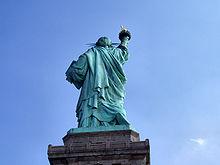
A: The shorty answer comes with the scientific one involving the oxidation of the Statue of Liberty’s copper skin through exposure to rain, wind and sun. It turns green through a process known as verdigris. Apparently, Bartholdi was not aware that would happen when he chose those materials to work with.
Q: Has she closed much during the 13 decades she’s been around?
A: in reality, not much. In 1984, the statue was closed to the public and underwent a massive restoration in time for its centennial celebration. Even as the restoration began, the United Nations designated the Statue of Liberty as a World Heritage Site. On July 5, 1986, the Statue of Liberty reopened to the public in a centennial celebration.
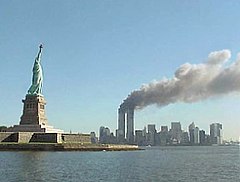
After the terrorist attacks of Sept. 11, 2001, Liberty Island closed for 100 days; the Statue of Liberty itself was not reopened to visitor access until August 2004.
In July 2009, the statue’s crown was again reopened to the public, though visitors must make a reservation to climb to the top of the pedestal or to the crown.
Q: All the popular men’s magazines once made a big to-do about listing their ladies’ dimensions. So, what are hers?
A: I thought you’d never get around asking that. The base of the Statue of Liberty was made of concrete, a technique especially daring for its time it was recent. Until the buildings were built of brick or stone. The use of concrete has emerged for its strength, but especially for its implementation speed.
This was particularly important since the fundraiser for the construction of the statue base was so slow that the statue, she was ready long before the first sod is given on Bedloe's Island! He had to catch up, hence the use of concrete.
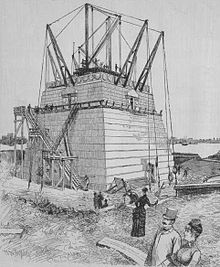
The foundations were sunk into a deep pit over 16 meters (53 feet) in the shape of a truncated pyramid whose base was nearly 28m and the top side, at ground level, 20m. They contain metal I-shaped beams which are embedded in the walls of the base and back to the top of the pedestal. It is these beams that came to be grafted later wrought iron structure of Gustave Eiffel.
Thus, the set makes only one block, foundations atop the statue. Imagine the accuracy of the technical disclosure in order to coordinate the two structures ... Especially that engineers were 6000 miles away. Under the bark of the granite pedestal facade lies a thick heartof massive concrete and steel beams on which the statue of the iron skeleton is attached.
The base itself was built as an extension of foundations, always concrete. This course is hollow, the walls are an average thickness of 2.50 m as they are a little thicker at ground level at the top. Always at ground level, measuring 20m structure aside and reduced to arrive, on the feet of the statue, at just over 13m. The central part, accessible measure 8.25m wide.
The total concrete architecture is the base of the Statue of Liberty built the largest building in the United States in the nineteenth century: 27,000 tons of concrete and stones, for a total of 12,200 cubic meters (13,300 cubic yards, to meet the English units). According to the time of words, the structure is so robust that they say that to overthrow the statue should reverse itself the island.
The construction ended April 22, 1886, with the laying of the last stone of the granite base.
The statue is located in the center of the fort Bedloe, a fort built in the mid nineteenth century to protect the harbor of New York. It was decommissioned and left without useful function until 1871, when Auguste Bartholdi, the sculptor of the future Statue of Liberty, came to New York looking for a place for its implementation. This fort provided a perfect base for the pedestal of the statue, the latter nesting in the fort itself.
Foundations made, masons began to raise Brittany stone on each other in layers. The base tapering, at its base, masons made wooden boxes they settled one above the other, a bit like a pyramid. The set was equipped with wooden stairs to masons, and cranes for the material. When talking about cranes, at the time, it was mainly an ingenious set of beams fixed V and provided at their ends with a pulley. Positioned in tilt with respect to the plumb walls, the forces required to pull the load is nullified in pairs, each set of beams being connected with another on the other side of the pedestal during assembly. The site used to a hundred men, though often they were less numerous in practice.
The weight of the Statue of Liberty is quite impressive too. This is of course the sum of the weight of the internal structure wrought iron (130 tons) and copper shell (88 tonnes). All therefore weighs approximately 220 tons, it is no longer close to 2 tons. As for the pedestal, it weighs too ... to find out. In fact it is composed of a huge concrete slab sinking into the soil taken in Fort Wood, and is composed mainly of granitic rocks. Suffice to say that its weight is much higher than that of a statue itself, which would appear very light in comparison. Note that for the envelope, it is not only the copper plates which are heavy, it is also the rivets, which individually are not heavy but the astronomical amount that there is the statue Increases weight considerably.
Other dimensions include:
Height from floor to the top of the torch
92.99 m (305 feet)
Height of the statue
46.05 m (151 feet)
Height of the Pedestal
46.94 m (154 feet)
Height from the feet at the top of the head
33.86 m (111 feet)
Height from the top of the head at the top of the torch
12.19m m (40 feet)
Length of right arm
12.80 m (42 feet)
Head height
5.26 m (17 feet)
Head width
3.05 m (10 feet)
Inter-orbital space
0.76 m (2.5 feet)
Width of an eye
0.65 m (2.1 feet)
Nose length
1.37 m (4.6 feet)
Larger radius of the crown
3.50 m (75 Kg, 9 feet)
Width of the mouth
0.91 m (3 feet)
Finger Nail
0.33 m x 0.65 m (1 x 2.1 feet)
Length of the index finger
2.44 m (8 feet)
Circumference of the index (in the 2nd phalanx)
1.44 m (4.3 feet)
Hand length
5.00 m (16 feet)
Length tablet
7.19 m (23.5 feet)
Width of the tablet
4.14 m (13.5 feet)
Thickness of tablet
0.61 m (2 feet)
Width size
10.70 m (35 feet)
Length of a foot
7.65 m (25 feet)

Approximate heights of various notable statues:
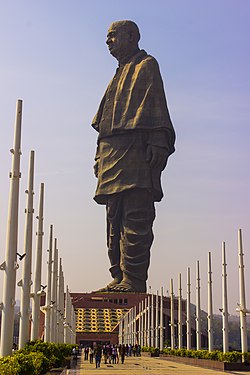
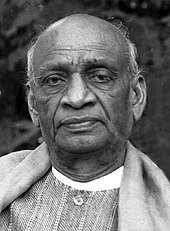
- Statue of Unity 240 m (790 ft) (incl. 58 m (190 ft) base) The Statue of Unity is the world's tallest statue, with a height of 182 metres (597 feet),[3] located near Kevadia in the state of Gujarat, India. It depicts Indian statesman and independence activist Vallabhbhai Patel (1875–1950), who was the first deputy prime minister and home minister of independent India and an adherent of Mahatma Gandhi. Patel is highly respected for his leadership in uniting 562 princely states of India to form the single Union of India.
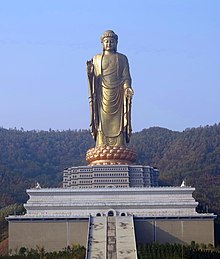
- Spring Temple Buddha 153 m (502 ft) (incl. 25 m (82 ft) pedestal and 20 m (66 ft) throne)
- Statue of Liberty 93 m (305 ft) (incl. 47 m (154 ft) pedestal)
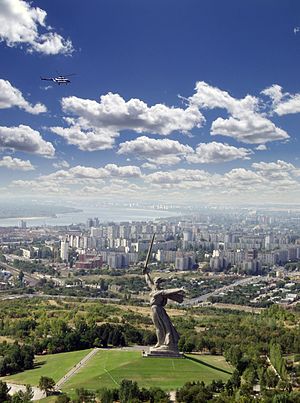
- The Motherland Calls 87 m (285 ft) (incl. 2 m (6 ft 7 in) pedestal)
- Christ the Redeemer 38 m (125 ft) (incl. 8 m (26 ft) pedestal)
- Michelangelo's David 5.17 m (17.0 ft) (excl. 2.5 m (8 ft 2 in) plinth)
Creative Commons Information:
- CC BY-SA 3.0
- File:Height comparison of notable statues (vector).svg
- Created: 24 July 2013
1. Vallabhbhai Patel (1875–1950)