
A Survivors Story....
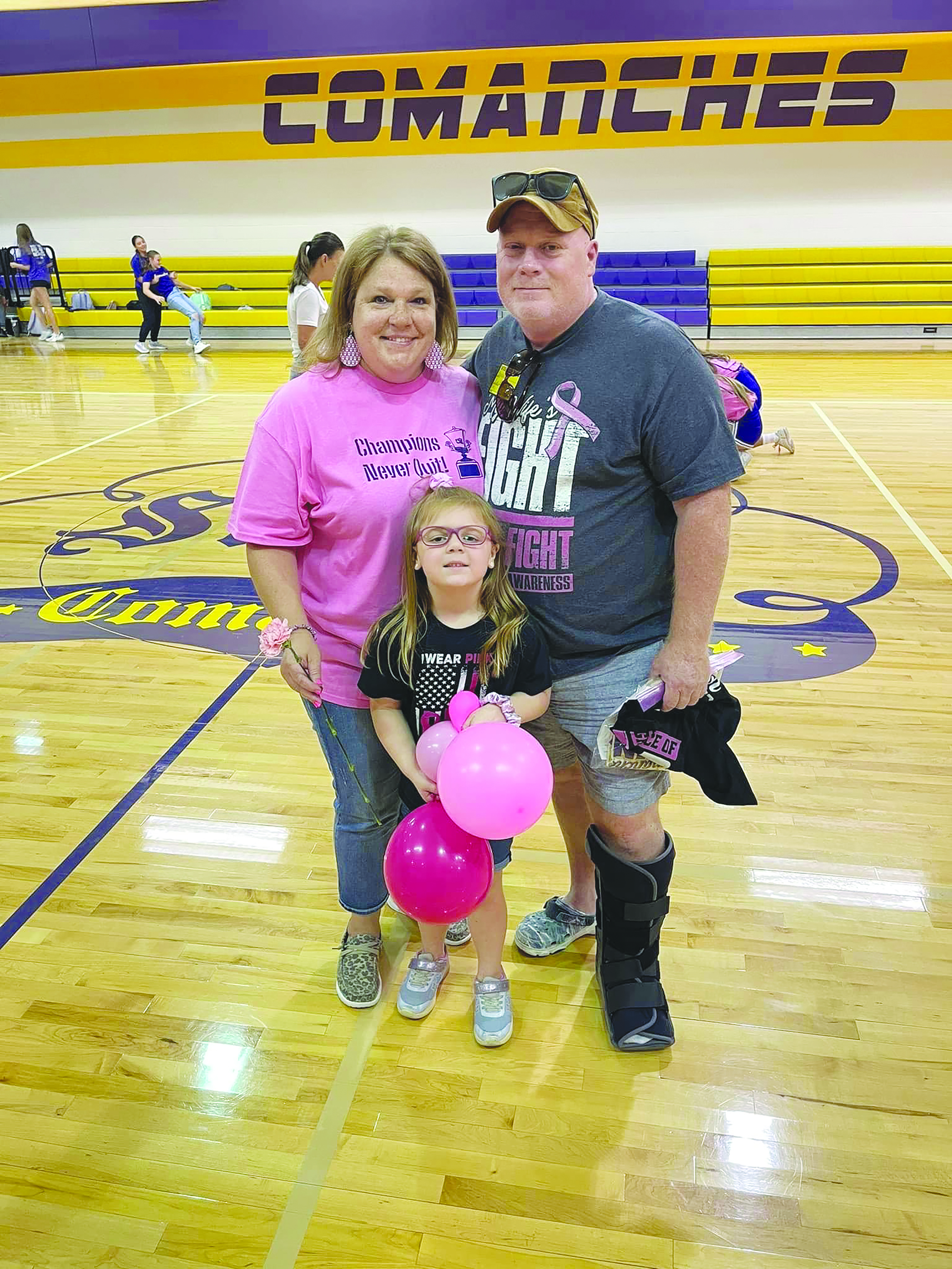
October is Breast Cancer Awareness Month, and a Shiner native aims to get the word out on the importance of this month.
Audra (Migl) Sapko was diagnosed in April of 2022 with stage three breast cancer, and she has learned a lot since her diagnosis.
“I was due for my mammogram in November of 2021, and I kept putting it off, but I finally went, and had it done,” Sapko said. “The day after I had it done was when I found the lump. I didn’t even think that I had breast cancer, I was just going for my yearly mammogram.”
Approximately 13.1% of women will be diagnosed with female breast cancer at some point during their lifetime, according to the American Cancer Society. The median age at the time of breast cancer diagnosis is 62. This means that half of women with breast cancer are diagnosed before age 62 and half are diagnosed afterwards. Sapko said this shouldn’t stop women from getting checked at an early age.
“Shedding light on breast cancer awareness is important,” Sapko said. “I love that we work so hard during October to get the word out there to people to get their mammograms and get tested. I wish it was promoted all the time, but there’s several other cancers and diseases out there as well that need attention.
Doctors are working to push mammograms for women sooner and younger than 40. I know in several of the groups that I’m in, I can’t even begin to count how many 20- and 30-year-olds that have been diagnosed accidentally and they had breast cancer. For some, it was even late stages.
Insurance companies, from what I understand, don’t cover it before 40 unless there’s a major reason; however, there’s been a movement where doctors are pushing this to get done sooner. One of the groups I’m in, ‘Pink Warriors,’ are really pushing for this.”
Everything moved pretty quickly once Sapko was diagnosed.
“I went in for my ultrasound, and they came in and talked to me saying they were pretty sure that what I had was cancerous,” Sapko said. “They had already called one of my other doctors to let them know and I immediately went to see her, and she sent me to a breast cancer surgeon. The day after that, I went in for a biopsy and a whole bunch of blood work. I had to wait all weekend long for them to say I was stage three cancer with invasive ductal carcinoma (IDC).
It had spread to my lymph nodes and my next steps were to start chemo. That was almost immediately. I did 12 rounds of chemo and, once my body recouped after the chemo, I had surgery. I had a left side mastectomy with all the lymph nodes on my left side removed. After I recovered from that, I started radiation, and I had 32 rounds of radiation. It was pretty difficult. It’s a day-to-day thing.”
IDC is the most common form of breast cancer accounting for 80% of all breast cancer diagnosis according to the American Cancer Society.
“There’s so many different types of breast cancer and that’s what people don’t understand,” Sapko said. “My doctors said that the type that I had was one of the better ones you could have because it is curable. It could have already spread to multiple different places, and I would have been stage four.”
“Medical technology has come so far over the years in detecting and treating it. When I went and met my doctor for the very first time, she said, ‘we are going to work toward curing you, not just treating you.’ The medicine they have these days is just unbelievable.”
Sapko is now cured; however, Sapko said that her cancer diagnosis has affected herself and her family a great deal since.
“It’s stressful,” Sapko said. “We talk about it. My daughter doesn’t know or understand, but she knows that I had surgery and that I was sick. She still asks me, ‘how’s your owie?’ or ‘does your owie hurt?’ My husband has been amazing. Anything I need, and he is right there. He’s been absolutely wonderful through it all, but we do have stressful times.
Each time I go for a PET scan or a mammogram or have blood work, there’s always that ‘what if?’ I’m still in my two-year mark from my surgery. Two years from your surgery, the likelihood of it coming back is much higher.”
Oct. 25 will be the official two-year mark for Sapko.
“There’s been a lot of people praying for me and us praying,” Sapko said.
One thing Sapko wished she knew before she started treatment was how absolutely exhausted she would be during it.
“I never would have imagined how exhausting it would be after my surgery,” Sapko said. “I would have to lay down and sit and do nothing for a minimum of 15 minutes. You have to take care of your body and listen to your body. You have to take the time for you and do what’s best for you because you’re no good to anybody else if you can’t function.”
“I’ve kept on top of my medication and have been keeping in touch with my doctors. I am still on my medication and it’s still a struggle every day. They wipe you out. The muscle pain and the joint pain that you deal with daily is insane. On the bright side though, you know that it’s keeping your cancer away. It’s better than the alternative.”
Sapko did find that other people outside of her family were supportive of her breast cancer journey.
“Everyone from my friends to my cousins to parents were supportive,” Sapko said. “They were wonderful. I have a three-year-old and my friends and my mom would come and help and give me a break. You must have a support system. I don’t know how the people who don’t have a support system get through it. My heart goes out to them.”
“One piece of advice I would give on how to best support a loved one going through breast cancer is to make sure that they know that they have all the help right at their fingertips. Don’t try to do this by yourself.”
Sapko has connected with other survivors. She is part of several groups on Facebook where people share their stories and their journeys through breast cancer. She encourages those feeling lonely in their diagnosis to reach out to people.
“Pink Warrior” group is one of the biggest support systems near Shiner. The closest one where those struggling can meet is in New Braunfels at 36 Nafta Circle, New Braunfels.