

Texas A&M AgriLife Extension Service study shows toxicant effective tool to reduce feral hog populations
Two-year study reported sharp declines in numbers and property damages when
used correctly and consistently
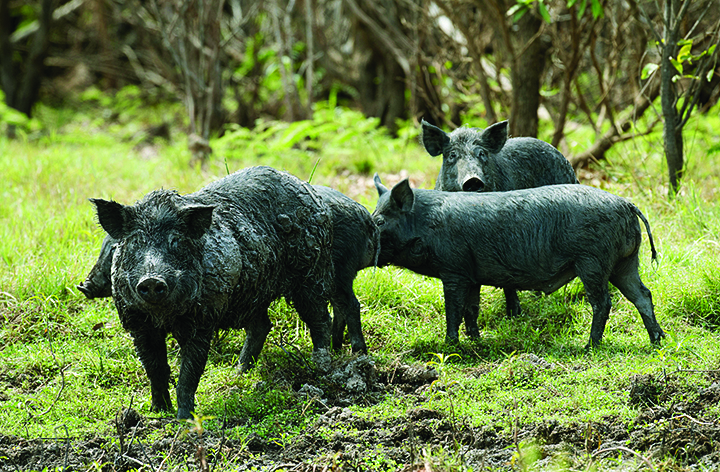
Staff Reports
A warfarin-based toxicant has been shown to be an effective option for landowners in the
control of feral hog numbers and damage on their property, according to a study by the
Texas A&M AgriLife Extension Service.
The two-year study was conducted by Department of Rangeland, Wildlife and Fisheries
Management associate professor and AgriLife Extension wildlife specialist John
Tomeček, Ph.D., and Michael Bodenchuk, director of Texas Wildlife Services. The
evaluation took place on 23 sites in 10 counties across the various regions of the state.
Tomeček said his and Bodenchuk’s team were able to reduce feral hog numbers
effectively and efficiently with diligent application of the product.
“Texas A&M AgriLife Extension Service was tasked with evaluating the product’s ability
to reduce feral hog numbers and damage in regions across the state and seasons of the
year,” Tomeček said. “We found that it can be highly effective when utilized correctly and
saw no access to the toxicant by non-target species when all feeder devices functioned
properly.”
John Sharp, Chancellor of The Texas A&M University System, said the study is an
important step in the fight to curb the economic and environmental impact of feral hogs
in Texas and across the nation.
There are more than 3 million feral hogs that cause more than $500 million in damage to
agriculture and private property throughout Texas each year, according to the most
recent economic estimates. Feral hogs are a burden on native wildlife and responsible
for widespread disturbances within native ecosystems.
“Texas A&M AgriLife experts are the leading authorities on feral hog control in the nation, and we are the first to test this in a real-world application and to show that this warfarin-based toxicant can be effective for reducing these pests,” Sharp said. “Unabated feral hog populations threaten our natural resources, our livelihoods and our quality of life, and our goal, as a land-grant institution, is to provide safe, effective, science-backed solutions for all Texans.”
Evaluating toxicant as a tool
The goals of the study were to conduct field evaluations of a low-dose warfarin-based
toxicant to determine its efficacy in various regions of the state and to assess the product’s ability to help landowners prevent property damage and economic harm from feral hogs.
The team of AgriLife Extension specialists worked with private landowners on
recommended application methodologies to provide real-world testing conditions for the
product and the suggested best practices.
Bait that included warfarin was placed in specially designed dispensers that prevent
access by non-target species, Tomeček said. Feral hogs were conditioned to access the
bait before the product was applied. Once the product was applied, feral hogs consumed
lethal doses within five days of consistent access to the bait.
The product is not considered acutely toxic to non-target animals in the event some
might gain limited access to the bait nor is it found at lethal levels within the tissue of
deceased feral hogs, Tomeček said.
Correctly and consistently are the key words for effective use of warfarin, Tomeček said.
After a trial period of close supervision and instruction, landowners in the study applied
and managed the bait themselves. During the project, the Texas A&M AgriLife team
made several discoveries that will help increase efficacy of the product when applied.
Landowners who checked the feeder for mechanical issues and replaced bait
consistently as part of their regular maintenance schedule reported sharp declines in
feral hog numbers and damage levels over the seasons of the year. Landowners who
did not adhere to instruction reported mixed to low success in curbing feral hog numbers
on their property. These results were true, regardless of the season of the year or the
region of the state where the trial was being conducted.
Rick Avery, Ph.D., AgriLife Extension director, said AgriLife Extension is dedicated to
providing effective, science-backed tools and information to Texas landowners dealing
with feral hogs. “This toxicant is a new tool to have in the toolbox as we deal with feral
hog populations across the state,” Avery said.