

Texas man pleads guilty in trailer deaths of 53 migrants in San Antonio

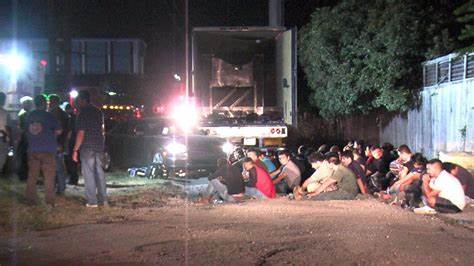
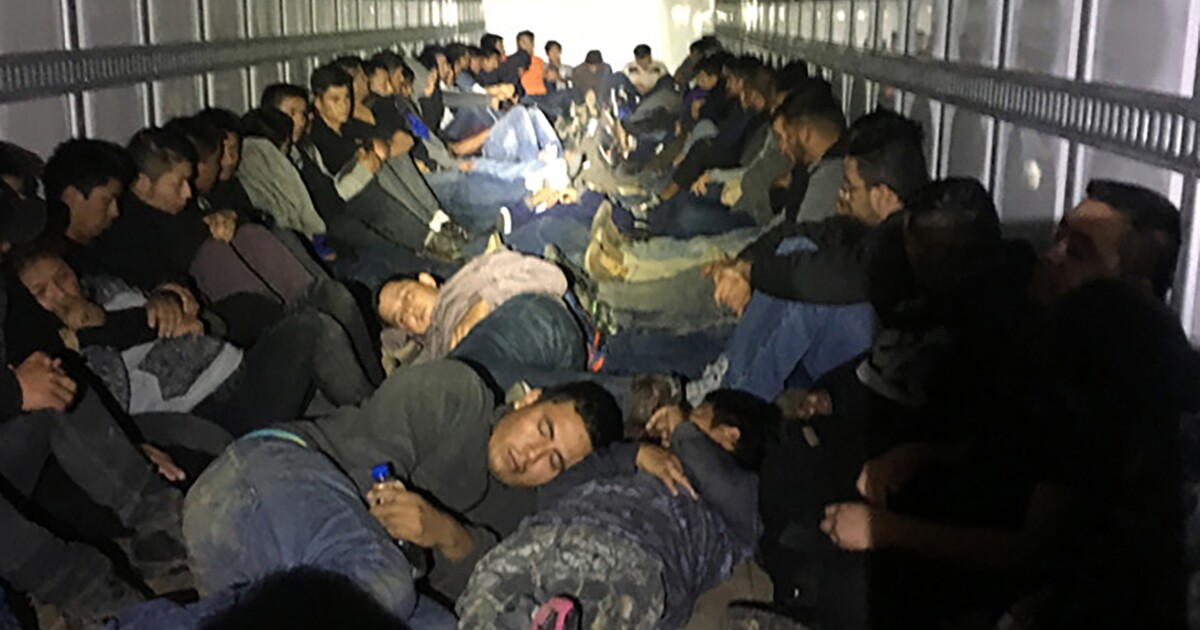
One man has pled guilty in the death of more than 50 immigrants who were discovered abandoned in the back of a semi-truck trailer in June 2022.
Christian Martinez, 29, pleaded guilty in the Western District of Texas on Wednesday, Sept. 27, to multiple counts of conspiracy to transport and transportation of people who have entered the country illegally that resulted in death and serious bodily injury, according to a news release from the federal prosecutor’s office in the case.
Martinez, from the Texas town of Palestine, was indicted along with five other men in connection with the transport, including Homero Zamorano Jr., 47, of Elkhart, who allegedly abandoned the vehicle on Quintana Road in June 27, 2022.
Martinez helped coordinate the transport and communicated with the other men allegedly involved. More specifically, Martinez drove Zamorano to San Antonio to pick up the semi-truck.
Zamorano is accused of later abandoning the trailer, not equipped with air conditioning, that was filled with 66 immigrants from Mexico, Honduras, and Guatemala.
Zamorano was reportedly high on methamphetamines, news reports stated, and he was later found in nearby bushes.
In the end, 53 people died from heat-related injuries and suffocation. Three of them were children.
Martinez is set for sentencing on Jan. 4, 2024. He faces life in prison.
The four other men indicted in the case include Riley Covarrubias-Ponce, 30; Felipe Orduna-Torres, 29; Luis Alberto Rivera-Leal, 38; and Armando Gonzales-Ortega, 54.
Sound familiar?
The truckload of bodies found in San Antonio was no doubt reminiscent of another case much like it from more than 20 years ago now. In that case, 19 people died after the truck was abandoned along a side road within stone’s throw of a busy convenience store a few miles south of Victoria in May 2003, in an area known as the Quail Creek community.
The sealed trailer that transported at least 74 illegal immigrants in May 2003 was described by prosecutors at one time as a “rolling chamber of death.”
Lavaca County Precinct 1 Justice of the Peace Steven Greenwell remembers it well, he said at a recent townhall meeting of 120-plus Lavaca County residents who gathered to learn more about what they might do to help law enforcement in their ongoing battles against human traffickers and the sexploitation so many of its victims are subjected to.
Greenwell was brought in to head up a newly formed investigative field office that continues today under the auspices of the Department of Homeland Security. Theirs was one of the early pioneers of what they dubbed cybercrimes investigations, which as Greenwell described a few times now, “sure sounded cool but no one really quite grasped what it entailed just yet.”
Keep in mind, this was the early 2000s. Computers still made that god-awful squawking noise whenever they got online. Email accounts were a largely experimental project in most places still. And users of those very first digital cameras to the hit market swiftly learned what words like “pixelate” truly meant.
Facebook wouldn’t come along for about another year still, and it would take four more years beyond that before technologies like the iPhone get introduced. So, we made do myspace and messenger, we suffered through never-ending download speeds, and because it was the only item that worked with any degree of regularity, we got incredibly good at the game of solitaire. That’s what most of us did, anyway.
Criminals, meanwhile, mastered the art of stealing identities, along with every dollar in your bank account, using those very same tools. They traded truckloads of illegal narcotics for the pallets stacked with cash or entire arsenals of military-grade weapons and munitions, all while enjoying the relative safety afforded by being on the far side of an international boundary someplace tends to provide to the shot callers.
Not long after learning how to rig their phones to dump all data in a pinch, many began using something called “the dark web” to orchestrate a new way to make even more money, through the sale of human flesh, many of them no more than children, to the very type of people who pay top premiums because they’re children.
It was these darkest of crimes that Greenwell and his team of investigators worked from their Victoria field office, building case after case from crimes committed right here in our very own backyards.
Like the millions of images they amassed depicting vicious rapes inflicted on little more than babies in many cases, that were then marketed as pornography worldwide.
They contained images so vile that—as one of those investigators described at last month’s human trafficking town hall meeting in Hallettsville—good and decent parents couldn’t go home at the end of the day and bear even the simplest of things, like changing their own baby’s diapers or watching as they giggled in their baths, without feeling physically ill from all they’d witnessed at the jobs.
Flesh peddlers
As those trailer loads of people revealed in 2003 in Victoria and again 20 years later in San Antonio, those who left them there to die were never conflicted by a conscience.
Rather, they lured dozens of hapless immigrants together under promise of safe passage into these United States, people who unwittingly forked over their life’s fortunes and boarded—each making payments of between $1,800 to $5,500, per person, court records showed, the second half’s payment due upon arrival—only to be subjected to the types of horrors that nightmares are made of.
Court records show that passengers clawed holes in the walls barehanded and punched out taillights to try to get enough air to survive as temperature rose and the air thinned, literally baking them alive by the dozens.
The victims — from Mexico, Honduras, El Salvador and the Dominican Republic — died of asphyxiation, hyperthermia and dehydration. They included a 5-year-old boy, and four teenagers.